On a recent trip to Florida, I had the pleasure of a kayak nature tour through Estero Bay near Fort Myers. The guides were very knowledgeable and gave us a wealth of information about the many wading birds, including rare Reddish Egrets and Roseate Spoonbills and other aquatic life including the endangered manatees. It was wonderful to be able to experience these elements of the natural world in such close proximity to a developed urban centre.
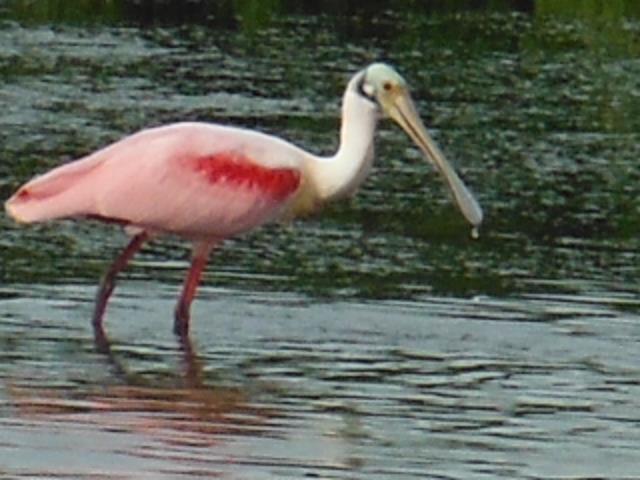
image of pink wading bird in a few inches of water

Roseate Spoonbill in Estero Bay, photo courtesy of Manatee Guides

However the next day after a hike through the Ding Darling Nature preserve we went to cool off in a swim at a beach on Sanibel Island and were a little dismayed to see a few dead fish on the shore. Later, watching the local news we heard there was a red tide bloom close by that had left hundreds of dead fish on Bonita Beach. I started to think about the similarities between red tide and blue-green algae in terms of their negative effects on aquatic eco-systems. Although both red tide (Karenia brevis) and blue-green algae (Cyanobacteria) are naturally occurring(historical records describe occurrences from several hundred years ago) there is no question that the frequency and size of these blooms are increasing.

Here is a time line of the occurrence of red tide along the southwest coast of Florida dating back to the 16th century. 1998 was the first year of an unbroken run of annual red tide episodes and 2005 saw a red tide bloom that lasted most of a year and resulted in a dead zone near Sarasota, the size of Rhode Island.

It’s fascinating( in a perverse way) that the timing of the increased frequency of red tides off the southwest coast of Florida is so similar to the increase in size and frequency of blue- green algae blooms in Lake Winnipeg , where they first came to public attention in the late 1990’s. Both are fueled by an excess of nutrients, phosphorus and nitrogen, that is being flushed into our waters from human waste, animal waste, fertilizers and natural run- off. The amount getting into the waters is increasing due to the frequency of flood events, increased drainage throughout our landscapes, and general increased human development. The similarities between red tides and blue-green algae blooms are obvious in terms of their negative effects including threats to aquatic life, loss of income for communities reliant on fishing and tourism and decreased property values on shorelines and water quality decline.

My recent experience in Florida combined with news of terrible blue-green algae blooms throughout many American States this year and finally the deteriorating state of Lake Winnipeg, make me think that these water quality problems are becoming overwhelmingly rampant. We must take action immediately to stop the flow of phosphorus and nitrogen into our waterways. We know how to do it, now we just have to commit resources and energy to get going on it.
Posted by: Vicki Burns | October 1, 2012

Late Season Algae Still Poses Threat

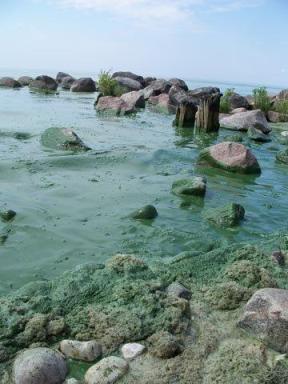
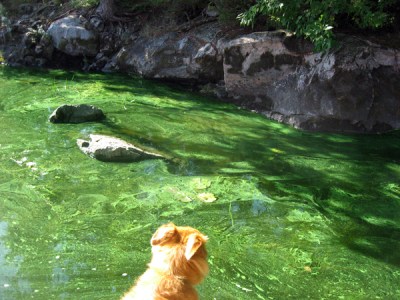
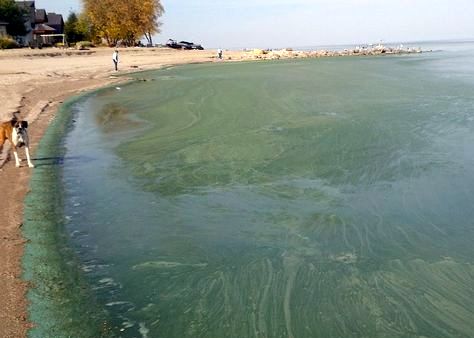
Here is a picture of blue-green algae which washed up on a beach near Gimli on Lake Winnipeg, just a couple of days ago. Its unlikely that any humans will be swimming in the water this late in the season but if you look closely you’ll see a dog standing right at the edge of the water. Its so dangerous for dogs to go in water with blue-green algae because they lick their fur when they come out, thereby ingesting possible toxins in the algae. This year I’ve noticed many more warnings of the risks to dogs throughout North America and across the Atlantic in Britain as well. There have been several dog deaths reported in the States this year.

image of dog standing on beach at edge of blue-green algae covered water

Blue-green algae Gimli, Lake Winnipeg Sept. 2012 photo credit Emery Gal

Just today I saw this news clip from New York State that is warning of the health hazards of exposure to blue-green algae. In this report they are saying that this year there have been 100 cases of human illness related to exposure to the algae. Dr. Jeffrey Reutter of Ohio State University is quoted as saying there will be human death soon if we don’t somehow slow the growth of this toxic algae. I don’t like to be a fear mongerer but I do think we need to pay serious attention to the increased warnings we’re seeing all over the world about the threats to human and animal health as well as to the aquatic life due to exposure to large amounts of blue-green algae.

In Lake Winnipeg, we are fortunate that so far the level of the toxin microcystin which is found in some blue-green algae, is not above the safe guidelines very often. When it is above the recommended safety guidelines the government posts notices on their website and on the beaches (if it is an area they routinely check).

At Lake of the Woods in the Kenora Ontario area, their public health officials have been issuing public notices advising people how to identify blue-green algae. They are offering to come out to check the water in any area where it is suspected to be the toxic algae. The point I’m really trying to make is that we should get moving much faster to decrease what is causing these algae blooms, the flow of phosphorus and nitrogen into our waterways. We do have some ideas about how to do this but it will require money and political will to get it done.

Posted by: Vicki Burns | September 25, 2012

Water Conservation – How Much Are We Each Using?

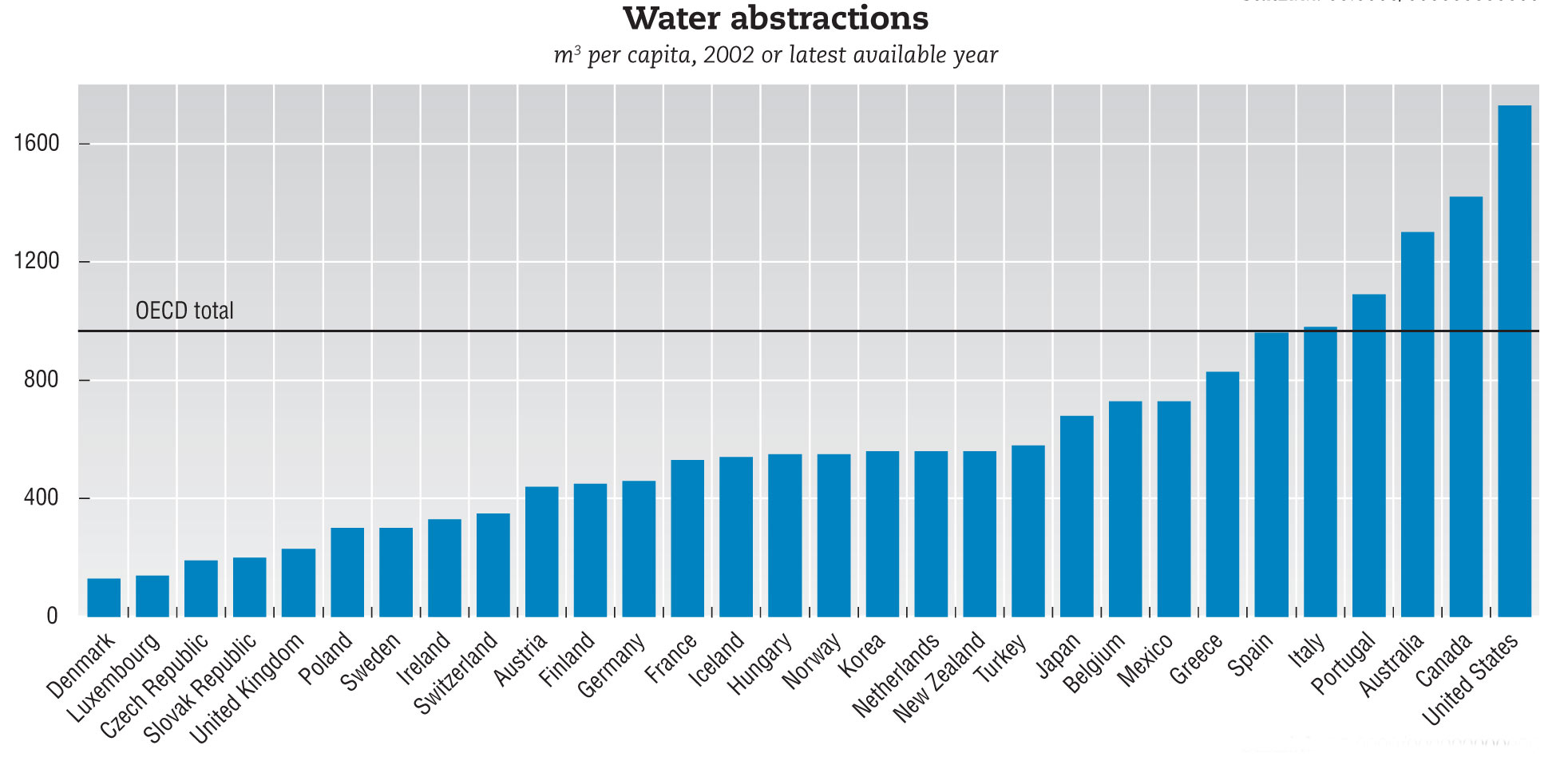
The idea of the importance of conserving water is gradually gaining more credibility in Canada. Although many people still seem to think we have an unlimited supply of safe, clean water there is growing awareness creeping into our collective consciousness that maybe we’d better start paying attention to what we’re doing with water. The drought this summer in much of the mid-west USA is reminding us that something similar could happen across the Canadian Prairies. Given that we in Canada are the second highest consumer’s of water in the developed world , we have much room for improved conservation.

image of graph comparing per capita water use in Canada and 15 other countries

Canada’s High Water consumption Record

So I was very interested to see a Water Footprint Calculator put out in the National Geographic website recently. It is an easy little survey to help each one of us figure out whether we’re using more or less or about the average amount of water used by other North Americans. I was feeling quite smug about many of the things we’ve done in our household to decrease water use( low-flow toilets and showerheads, etc.) until I came to the other sections about our consumer habits and our annual travel. It’s quite amazing to learn nearly 95 percent of our water footprint is hidden in the food we eat, energy we use, and products we buy. It’s a whole other learning curve to start paying attention to the water footprint of everything we buy. However, given that the future of our species depends on an adequate supply of clean, safe water this will be a learning curve that we’ll have to have to master in the near future.

A couple of weeks ago I was interviewed by Alex Paterson who writes for the University of Winnipeg  paper, The Uniter. He was writing an article about the federal government’s recent announcement of $18 million more for the Lake Winnipeg Basin Initiative over the next 5 years. The Lake Winnipeg Foundation had sent out a press release thanking the federal government for this announcement but cautioning the public that probably a major chunk of that money would be going to pay staff already on the payroll at Environment Canada and Fisheries and Oceans. In the first phase of the Lake Winnipeg Initiative of $17 million, only $2.46 million went to “on the ground” new projects geared to decreasing excess nutrients getting into our waterways.  Most of the rest of the money went to staff in those federal departments.
We appreciate the valuable work done by Environment Canada and DFO staff. Our public comment was not to diminish the value of their work but rather to alert the public to the need for a much greater amount of money to fund projects, like wetland protection and restoration, that will decrease flood threats, decrease excess nutrients flowing into our lakes and mitigate for future drought threats.
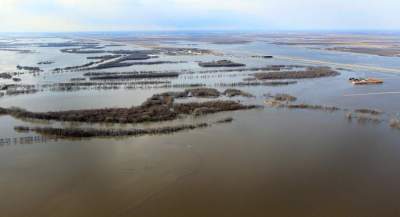
In researching information for the article Alex Paterson wrote, he requested some concrete information from the federal government on the breakdown of the money allocated to the Lake Winnipeg Basin Initiative. You can see the specifics in this follow up article he wrote but the information I found most striking was the amount spent on flood disaster relief in Manitoba over the last 10 years.
2002/2003       $2,747,649

Flooding in Manitoba 2011

2003/2004       $-
2004/2005       $7,292,493
2005/2006       $37,694,417
2006/2007       $7,045,162
2007/2008       $23,552,493
2008/2009       $565,937
2009/2010       $-
2010/2011       $40,286,253
2011/2012       $50,000,000
2012/2013       $58,941,680
Total           $228,126,084
Add to that amount the $850,000,000 we spent in Manitoba in one year alone (2011) and you can see that the cost of floods is really adding up.  The amount of money we’ve spent on flood disaster relief is well over $1 billion now. The amount we’ve spent on preventative measures such as wetland protection and restoration is miniscule in comparison( possibly $2 million).  Isn’t it time to get serious about investing in some preventative measures that will decrease flood risks at the same time as helping to clean up Lake Winnipeg?

Posted by: Vicki Burns | September 9, 2012

Blue-green Algae in Oklahoma Cause Illness in 46 People

I was surprised to see this headline pop up in the last few days. “Oklahoma reports 46 people ill from exposure to blue-green algae”. It is one of the few times I’ve seen an actual official statement about people becoming ill from exposure to blue-green algae. The warnings we’re seeing all over North America, including in my home province of Manitoba, are becoming more frequent and more serious this summer. However in Canada, at least in Manitoba, I’m not aware of any official government department tracking cases of illness caused by blue-green algae.

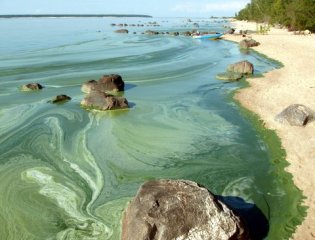
Blue-green algae on shores of Lake Winnipeg

Anecdotally, I’ve heard from a few people about instances of human illness caused by exposure to the algae, including a windsurfer who found himself in the middle of a bloom after surfing out a distance from shore. The sight of the turquoise-streaked water that is indicative of the presence of blue-green algae would seem to warn people away by virtue of how unnatural it looks. However if it is a windy day, the algae will get mixed in with the water and not be nearly as visible.
There is good information available about the possible human health effects of exposure to blue-green algae as noted in this information from the World Health Organization but I think it will be important for governments in Canada to start a system for recording data on how many people are becoming ill related to blue-green algae. That kind of information may cause many more people to pay attention to this growing threat to our freshwater and ultimately, to take action to decrease the problem.

The Lake Winnipeg Foundation has decided to add its voice to the growing list of organizations and individuals who support a ban on the use of cosmetic pesticides in Manitoba. The government of Manitoba, in its recently released Tomorrow Now, Manitoba’s Green Plan, is calling on Manitobans to voice their opinion on the issue of the cosmetic pesticide use by October 1, 2012.
Many other provinces including Ontario, Quebec, Nova Scotia and Prince Edward Island, have already implemented a ban on the cosmetic use of pesticides because of the concern that pesticides can have negative effects on human health. There is also a significant environmental threat in that cosmetic pesticides can impact ground and surface water as well as fish and wildlife.
At this point in time we are not certain of what accumulation of pesticides have entered Lake Winnipeg via run-off from urban lawns but given the serious threat that these cosmetic pesticides pose, we are advocating for the precautionary principle. It is important to note that what we are proposing is to stop the use of these pesticides for reasons that are simply aesthetic, not to stop them in the production of food. It simply doesn’t make sense to create unnecessary threats to human and animal health, wildlife and the environment, in order to create pretty lawns and gardens. Organic lawn care programs offer alternatives.

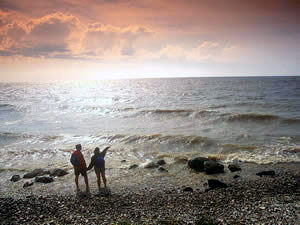
image of 2 people on shores of windy lake

Lake Winnipeg, photo courtesy of Travel Manitoba

I’m pleased that the Lake Winnipeg Foundation has joined with many other national and provincial organizations like the Canadian Cancer Society, The Canadian Association of Physicians for the Environment, and the David Suzuki Foundation to name just a few, who are trying to put a stop to a practice that is so clearly unnecessary and poses so many threats to the health of our natural world and all of us who depend on it.

Posted by: Vicki Burns | August 20, 2012

Blue-Green Algae Causes Dog Deaths- Help Spread This Warning

I’m glad to see some news this summer on Canadian mainstream media about the serious threat that blue-green algae poses to dogs. It has concerned me that so many people have been unaware of the potentially lethal effects that it can have on dogs.

As well, I’ve been amazed to hear anecdotally about people at Grand Beach in Manitoba who don’t seem to understand the serious health threats to humans as well. Someone told me a story about people wading through a wide swath of foamy blue-green algae to get to deeper water where the algae was not so visible. Considering that some of the blue-greens contain microcystin toxins that are damaging to the liver, as well as causing nausea, headache, vomiting, abdominal pain, diarrhoea, gastroenteritis, and muscle  weakness, it seems quite foolhardy to be wading right into it.

blue-green algae at Minaki, Ontario 2011 – courtesy of Todd Sellers

Getting back to the threat to dogs though, one of the reasons it is so lethal for our canine friends is that they tend to lick themselves when they get out of the water, thereby ingesting the toxins. Many other American and British jurisdictions seem to track dog deaths and report them which is not happening much in Canada yet. In Britain, I found this warning in the Nottingham area that confirms 10 dog deaths between 2008 and 2010. In Minnesota during the 2007 summer season, which was considered a drought, they reported 40 cases of canine poisoning. Last year in 2011, there were 5 dog deaths and 17 people ill as a result of blue-green algae around Milford Lake in Kansas.  These are just a few of the reports I found while researching this subject.

In Canada, I’m not aware of any formal reporting mechanism for dog deaths due to blue-green algae poisoning and this may be why so many people here are still ignorant about the dangers of letting their pets go near the waters infected with that type of algae. As a dog lover though, I certainly know the heartache one would suffer if a beloved pet died in such a preventable manner. I hope we can get this warning out there more widely.

The Lake Winnipeg Foundation’s biggest fundraiser, “6th Annual Walk for Water” is happening this Sunday August 12 but organizers are worried that last week’s federal government announcement of $18 million has overshadowed the need for grass-roots fundraising. The Foundation is grateful for every dollar that government commits to helping the lake but a large portion of the recent money announced will go to funding core staff within Environment Canada, not to concrete projects on the ground that will decrease the phosphorus getting into the lake.

Blue-green algae on beach on Lake Winnipeg

“We’re concerned that many of the public think the federal government’s recent announcement will pay for everything needed to save the lake. We know that is not the case and we urge the public to support our Walk for Water and other Lake-A-Thon events” says Karin Boyd, President of the Lake Winnipeg Foundation.

There are a myriad of local projects that need to happen across the landscape to stem the flow of excess nutrients that are feeding the toxic blue-green algae blooms.  The Lake Winnipeg Foundation offers support to many of these projects and is the only NGO whose sole aim is to advocate strongly for measures to restore the health of our great Lake Winnipeg.

The Walk for Water Fundraiser is happening this Sunday morning at Victoria Beach, Gimli, Matlock and Grindstone.

The Lake Winnipeg Foundation (LWF) is preparing for their 6th Annual Walk for Water event next Sunday, Aug.12 which has now grown to include four communities, Matlock, Gimli, Grindstone and Victoria Beach. The 5 km. walk through each community raises money for the multitude of projects that the LWF helps to fund that are aimed at restoring the health of Lake Winnipeg and its great watershed. Last year about $45,000 was raised through the walk and the hope is to exceed that figure this year.

image of woman walking with 2 dogs on beach at sunset

Enjoying sunset on the lakeshore

The Walk for Water is now the anchor event in a broader fundraising appeal called the Lake-A-Thon. The idea is that many people may want to contribute to fundraising efforts for the lake without participating in the walk. So there are endless possibilities for fundraising, from holding a garage sale to donating birthday money instead of getting presents. Here are some of the things people have done in the last couple of years: Swim competitions; Sail boat races;  Loonie for the Lake ; Sand-Castle Challenge; Mowing Lawns for the Lake; Shoreline clean-up  (e.g.,  pledges for  collecting X kg of garbage).
Another major fundraiser for the LWF is the Golf Fore Water, happening on Aug.28 at Larter’s Golf Course in St. Andrews. Thousands of Manitobans are golf fanatics. Hopefully many of them will fulfill their golf pleasures at the same time as helping to raise money for our beloved Lake Winnipeg.
2012 has brought many beautiful, hot summer days but also, many warnings about blue-green algae on Lake Winnipeg and other Manitoba lakes. There is greater awareness now about the threats associated with these algal blooms (health concerns for humans and animals as well as all life in the aquatic system). The Lake Winnipeg Foundation is working hard to increase attention and help for the lake. I hope there will be thousands of people who want to join in helping as well.

I routinely check the Lake Winnipeg Research Consortium( LWRC) website to see if they’ve put up any new satellite images of the lake. Now its easy to check both for satellite images and whether there are any new beach or algae advisories by going to the home page of the Lake Winnipeg Foundation where there are links to both the LWRC satellite images and to Manitoba Water Stewardship’s official site for beach advisories.
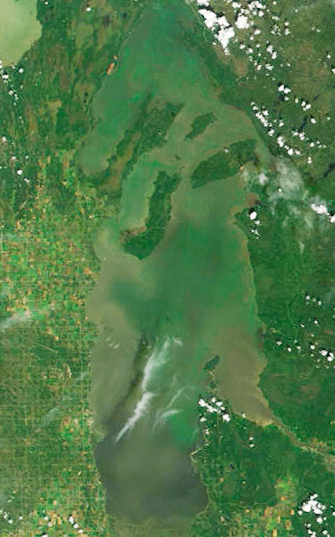
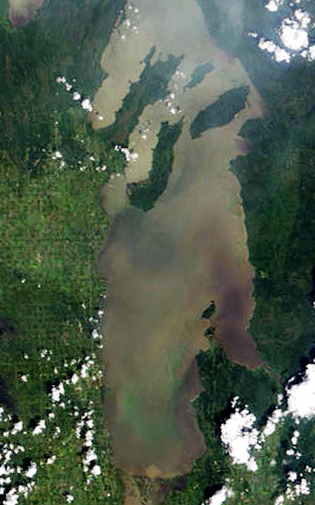
This year the algal blooms on Lake Winnipeg have started earlier than usual and the bloom in the south basin is much larger than usual. Thanks to the archived information on the LWRC website, I found a satellite image from July 24 two years ago and we’re able to compare it to the satellite image for this year on July 24.  It is quite remarkable what a huge bloom there is this year compared to two years ago, in the south basin and in the narrows area.  Unfortunately we’re still early in the summer season for blooms so its quite likely that the algae will become even more prevalent.

mage from space of Lake Winnipeg with huge algal blooms

Satellite image Lake Winnipeg July 24, 2012 showing large algal blooms in the south basin and narrows.

Being able to see the overall size of the algal blooms in these satellite pictures is really helpful because otherwise we have to rely greatly on anecdotal information from individuals who have encountered it in their areas. These images really drive home the point that Lake Winnipeg is being seriously threatened and we shouldn’t be wasting any time in trying to decrease the excess nutrients that are feeding these blooms.

Satellite image of south basin and narrows of Lake Winnipeg July 24, 2010 showing algal bloom starting in south basin

« Newer Posts - Older Posts »

Categories