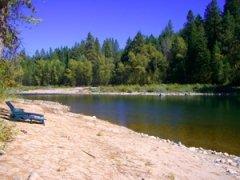
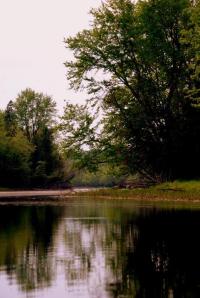
image of quiet waters with trees on the shore

Peaceful river scene, photo by Karen Cooper


Alexandra Cousteau is carrying on her grandfather’s quest to focus our attention on water by travelling across North America, drawing attention to the crisis faced by many of our water systems. Jacques Cousteau did amazing work in opening our eyes to the underwater world of the oceans. He would be very proud of his granddaughter’s efforts to get us to open our eyes to the threats facing many of our freshwater systems across North America. 

Check out details of Alexandra Cousteau’s Expedition Blue Planet tour to see what she might be doing close to your community.

I was encouraged to see this article Liquid Assets “Walking the Talk” Empowerment Through Investing  in the latest Water Canada magazine. Authors Milla Craig and Grace di Meo do a great job of describing the growing movement of sustainable/responsible investing and what it really means. 

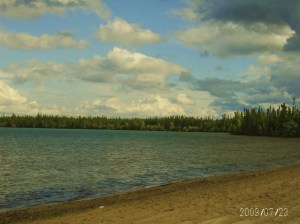
image of beach , lake and tree lined shores

Clearwater Lake, photo by Tanya Tran


 They point out that investments in sustainable/responsible funds are growing from fringe to mainstream, with many large mutual funds, pension funds ( including the Canada Pension Plan), and foundations paying serious attention to ESG ( environmental, social, governance)  factors in the companies they are investing in. 

 They go on to make the case for the inclusion of water in the  sustainable risk assessments as the issues surrounding water worldwide are increasing at an alarming rate.
I particularly like the final point they make, which is that each one of us can make a difference through our own personal choices in RRSPs and investments. What do you think the barriers are to more of us personally investing in sustainable/responsible funds?

According to this year’s list of most endangered rivers in British Columbia, the Kettle River shares the dubious distinction of topping the list along with the Sacred Headwaters. Water extraction, development and coalbed methane are sited as the 3 leading contributors to endangering these river systems. The Kettle River is already suffering from seasonal low flows and high water temperatures but these conditions are being further threatened by new development proposals that need significant water extractions. 

image of beach beside a river

Kettle River , photo from christinalakevacation.com


As is often the case, there are competing needs between economic development opportunities and environmental stewardship. The Kettle River Watershed Committee has been created to help think through the process of respecting and protecting the watershed at the same time as planning for current and future developments in the area. The Phoenix Foundation has been instrumental in helping to get this important committee started by giving seed funding of $5000. Not only are they providing financial support but one of the board members for the foundation, Becky Deane, is their representative on the Kettle River Watershed Committee. 

Becky described the Phoenix Foundation as “ the little engine that could” because they have done so much while starting with so little. Their community is small in size but large in terms of the passionate commitment of its members. The Phoenix Foundation of the Boundary Communities have completed their first Vital Signs report after tremendous efforts to engage and survey the public. The condition of their waterways is seriously threatened and the foundation is responding with both financial and human support. 

What a great example of a community foundation getting involved in multiple ways to protect our precious water. What do you think?

These days there is growing recognition of the need for Canadians to stop wasting water and learn how to conserve in the most efficient ways. As I mentioned in a previous blog,Water Conservation and Canada’s Poor Record, we have the unfortunate distinction of being the second highest per capita water users in the world. Every drop of water that enters our sewer systems creates wear and tear on our wastewater treatment systems and that adds up to a lot of dollars to maintain. But even more pressing in some areas of our country, water shortages are looming. So it makes sense in many ways, for all of us to stop wasting and learn how to use water in the most efficient ways. 

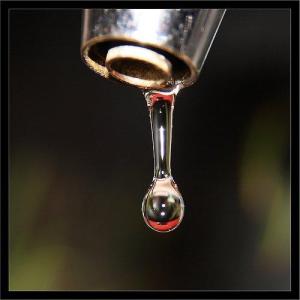
image of drop of water leaking from tap

Drop of water leaking from tap, photo by Hauke Steinberg

Sierra Club Canada and the Water Sustainability Project of the Polis Project, University of Victoria have joined forces to launch a community based water conservation project and they are looking for people from all over Canada to help them get started in 20 cities and towns across the country.
 Isabelle Gingras, Water Campaigner with Sierra Club Canada, asks “Are you, your organization or group working on water conservation issues in Canada?  Join ActionH20! We’re looking to work with environmentally conscious individuals, organizations and groups to engage in nation-wide efforts to enhance education on water conservation and create a lasting water paradigm shift. 

ActionH2O provides grassroots groups, community leaders and municipal staff with tools and resources to achieve sustainable water conservation practices in Canadian communities. From a comprehensive activist toolkit, to handbooks on how communities can save water and a cutting-edge online network of activists and community groups across the country working on water issues, ActionH20 seeks to save litres by cultivating leaders!” 

So please pass this message along to anyone you know who might be interested in getting involved. They can contact Isabelle via the Action H2O website.

The extreme rainfall, severe thunderstorms and flash floods just seem to keep on coming this summer. There are flood warnings for much of the Assiniboine River Valley and the city of Yorkton, Saskatchewan found itself under several feet of water on July 2. 130 people had to be evacuated from their homes, some in canoes and hundreds of homes have been damaged. 
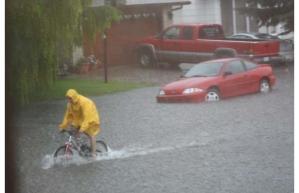
image of person riding bike through flooded Yorkton street

Intense rainstorm floods Yorkton , July 2, 2010 photo by Ian Berg


 The Premier of Saskatchewan  Brad Wall, announced that a cabinet committee has been formed to co-ordinate the province’s response to “unprecedented flooding faced by Saskatchewan people.” Premier Wall is quoted as saying “It’s unbelievable that much rain could fall in that short a span on a part of the province that’s already saturated. All of Saskatchewan’s like a big sponge that’s full right now, there’s no place for water to go.” 

All of these unusual events have really got me wondering what is causing such intense rainfall. I did a little research and came across this paper Global Warming and the Hyrologic Cycle which seems to offer a relatively easy to understand explanation for what we’re seeing this summer. As the concentration of greenhouse gases in the atmosphere increases, the surface of the oceans is warming. This in turn leads to a larger vapor-pressure difference between the sea surface and the adjacent atmosphere. This increases the evaporation rate, and hence the heavy rainfall we’re experiencing. Check out the article for a more thorough explanation. 

So, what can we do about all of this? I’m really interested in hearing from you if you have ideas. In future blogs I’ll be writing about some interesting work being done to improve the water holding capacity of our land, wetland reconstruction. But with all the disasters occurring around us this summer, it seems like we’d better get moving on adaptations to these changing weather patterns.
Tornado warnings, severe thunderstorm watches and flash floods are all making the news across the Prairies these days. The weather and specifically, the excessive amounts of rain are on everyone’s minds.  

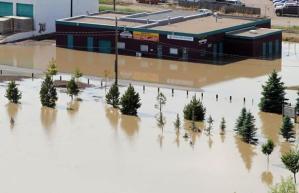
image of building in Medicine Hat surrunded by flood waters

Medicine Hat Flood , photo credit Gavin Young, Calgary Herald


 Medicine Hat and surrounding areas were hard hit by huge rainfall around the 3rd week of June which caused tremendous flash floods. Apparently this was a very unusual situation in that it was several creeks that overflowed and caused the almost instant flooding. The volume of rain that fell in such a short time was so much more than the earth could absorb. According to the Medicine Hat News, the flow rate of the Ross Creek shot up from an average of 5 to 8 cubic metres a second to 160 cubic metres per second. The flow rate of the South Saskatchewan River jumped from an average of 150 cubic metres per second up to 2300 cubic metres per second. Much of the flooding that occurred in Medicine Hat was in the middle of town, not close to the rivers but in the range of the creeks that were overwhelmed.  

Those numbers are astonishing to me and remind me of what scientists are warning in terms of more extreme weather events associated with changing climate patterns.  

The Medicine Hat Community Foundation has responded quickly to their community’s needs by announcing a fundraising effort to give timely assistance to victims of the flood.
They’ll be working closely with several organizations to provide help to people whose lives are in turmoil as a result of flood impacts. What a meaningful and concrete action for a community foundation to take in this crisis. I love their headline – “This is Our Community, These are Our People.” Lets hope they get a generous response.

The BP oil spill that is still occurring in the Gulf of Mexico has caused many people to question our preparedness for an environmental accident like this. Our confidence in the emergency response planning process has justifiably been shaken. 

Is it not prudent to halt any future off shore drilling for oil unless we can be sure that it is possible to develop a thorough plan should such a disaster occur in Canadian waters? I wrote to several members of parliament recently asking them to offer more protection to Canada’s oceans and was disappointed to get a very simplistic response from M.P. Randy Kamp, Parliamentary Secretary to the Minister of Fisheries and Oceans. 

Mr. Kamp stated “Natural Resources Canada is responsible for ensuring oil drilling platforms have appropriate response plans, and I can assure you that our Government has effective response mechanisms and safeguards in place in the unlikely and unfortunate event of a spill. The Canadian Coast Guard and other government agencies are well equipped to deal with any environmental event in our waters.” 

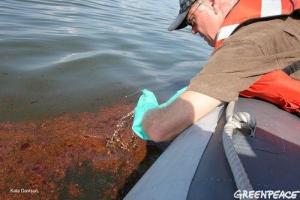
image of man leaning over the edge of the boat to collect sample of oil in the water

Biologist taking oil sample from Gulf of Mexico, photo credit Kate Davison/Greenpeace


If our coast guard and other government agencies are well equipped to deal with an environmental event like this, why are they not offering help to our American neighbours in the Gulf of Mexico? I have written back to Mr. Kamp asking this question and for more details about our Canadian safeguards . I’ll keep you posted on his response.

I was heartened to read in the news today that the premiers of the four western provinces and three territorial governments placed water near the top of their agenda at their meeting last week. They discussed concerns over water shortages in the future and water quality issues.

image of lake with tree covered mountains in the background

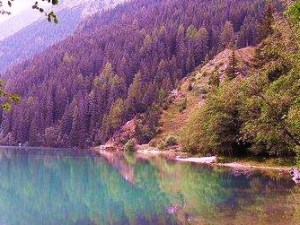
Lakeshore in the mountains

Their discussions referenced the impacts of climate change on our freshwater supply as well as our growing population, industry, and agriculture. The premiers’ attention to water concerns is encouraging but I don’t think we can rely on government alone to solve the problem. We all need to be part of the solutions to protecting our precious water now and for future generations. Why – because we need to alter our basic view of water as unlimited and we need to understand that what we allow to get into our water can cause problems now and for a long time.

One of the greatest challenges I see in the area of water protection, is the need to capture the attention of the general public.I’ve observed that there is already a good deal of work going on by various non-profit groups as well as government departments. But much of the learning from that work is not being transmited to the public.
Does anyone have any ideas about how to best bridge that gap?

All too often those of us who work on environmental issues, use terminology that is not widely known. We forget that the jargon we use is not in everyone’s vocabulary. The term watershed is a great example of that. I heard one of my colleagues joking recently that some people think watershed is the little building where you keep jugs of water. In relation to land, a watershed is the entire geographical area in which all runoff from streams, rivers, lakes is being conveyed to the same water body.

image of the Shuswap watershed poster

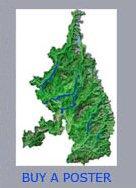
Shuswap Watershed Poster

The Shuswap Community Foundation was involved in a terrific project in their community that really helped people to understand what a watershed is and where they lived within their own watershed. The Shuswap Watershed Project used several different approaches to drive home the lesson about their local watershed and what was happening to it.

image of river with  tree covered hill in background

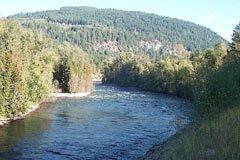
Beautiful Shuswap Scene

Understanding what a watershed is and our place within our local watersheds, is part of helping people to understand that we are connected to so many other communities via water. Our use of water impacts the next community downstream from us. The Shuswap Watershed Project is a great example of helping everyone to understand the importance of water and how we treat it.

Posted by: Vicki Burns | June 16, 2010

The BP Oil Spill in the Gulf of Mexico – What Can We Do?

The tremendous environmental disaster that has been unfolding in the last few weeks in the Gulf of Mexico has captured the attention of millions of people around the world. As is often the case, there is much finger pointing and blame being dished out. It seems its human nature to want to blame. But my reaction is slightly different and focuses on two aspects of this fiasco.

image of green turtle covered in oil

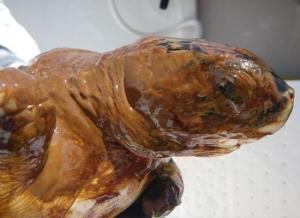
Green Sea Turtle covered in oil, photo credit Kristina Summer

The first is how can we make sure we don’t make the same mistake twice. Its obvious that no one has a good answer for how to stop the flow of oil into the Gulf of Mexico. Doesn’t that mean we should be extremely cautious about allowing any more drilling underwater? I am amazed to hear that our own Canadian government may be proceeding with issuing more drilling permits for the Arctic. How can we ensure common sense will prevail? Check out the David Suzuki Foundation’s suggestion for communicating with our political leaders.

The second thought I’ve been having was expressed very eloquently by Ingrid Newkirk, in a recent editorial entitled Largest case of cruelty to animals in U.S. history. As a former humane society executive director, I find the images of birds and marine animals suffering under the slick of oil, almost unbearable. However Ingrid has taken the pain of seeing such a huge amount of suffering and turned it into the question of what can we all do.  There are many large and small things that each one of us can choose to do to lessen our dependence on oil and oil based products, thereby decreasing the need to access more oil in environmentally threatening ways.

We can all make a difference to protecting the elements of the natural world that humans rely on for survival by making more conscious choices in our everyday actions. Are you willing to pick one thing you can do differently today?

« Newer Posts - Older Posts »

Categories