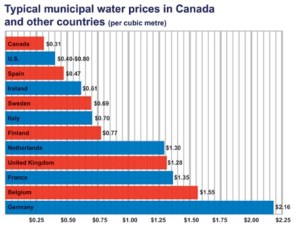
graph showing Canada's water prices compared to 11  other countries

Canada's Cheap Water Prices, World Commission on Water for the 21st Century

Last week I came across an interesting article about Canada’s water conservation practices, comparative water consumption record and comparative water pricing status. The gist of the article was that we have a long way to go in Canada to improve our status related to safeguarding our most precious resource, water. The article included a graph of typical municipal water prices in Canada compared to other developed countries. Canada had by far the lowest average price at $0.31 per cubic metre compared to the U.S. which had a range from $0.40 – $0.80 with the highest price in Germany at $2.16 per cubic metre.
The graph reminded me of another graph I had included in a blog several months ago that showed Canada’s water consumption rate compared to other developed countries. Not surprisingly, the only country that has a higher rate of consumption is the U.S. In Canada on average we are using over 300 litres of water per person per day which is 9 times greater than the average use in the U.K. and more than double the average use of the 16 countries compared in the chart.
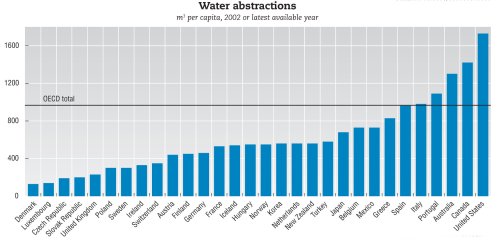
image of graph comparing per capita water use in Canada and other countries

Canada's High Water consumption Record, Conference Board of Canada

It seems to me that our cheap water pricing is contributing a great deal to our lack of attention to water conservation.It can’t help but contribute to the idea that we have so much water in Canada that we don’t need to worry about being careful with it. I am convinced that if we all have to pay more for the water we use, we will start to pay attention to how much we’re using and will start to think about how to use less. Most people don’t want to waste money; many want to save money so why don’t we tie those 2 motivators to our policies around water and see if that will bring about the change we need to see in our water conservation habits.
I know that increasing the price of a publicly provided resource/service like water and water treatment is not a politically popular idea. So how do we convince our politicians to move in that direction?


World Water Day, March 22, has stimulated great attention to many different aspects of water all over the world. One of the most amazing array of facts though, is how much water it takes to produce the everyday things we eat, drink and wear. Those of us who are working in the “water field” are calling this the water footprint. I am really astonished at the quantities of water it takes to produce even one cup of coffee – 37 gallons and 634 gallons to make one hamburger!

image of cup full of coffee beans

Coffee beans - photo credit Flickr Refracted moments

Check out this listing of food and products on the Huffington Post’s website. It really is surprising and makes me think twice about how we are going to manage in the future with the finite supply of freshwater that exists on planet earth. I’m reminded of a presentation I heard by Janine Benyus of the Biomimicry Institute. She was promoting the idea that we could learn so much from the natural world about how various life forms have developed adaptations to maximize their use of water and other essential elements. I think that kind of study will be of tremendous value to us as our thirst for water grows.

The Healthy Rivers, Living Lakes Concert in Winnipeg last Sunday afternoon was a unique and entertaining way to mark Canada Water Week and what it means to some of us in Manitoba. There was specific focus on Lake Winnipeg, Canada’s 6th great lake as well as general attention to the basic essence of water and its life giving value.

image of woman singing and playing guitar with man playing guitar in the background

Heather Bishop Wows the Crowd at the Living Lakes Concert

Through poetry, stories, photographs, art and music each performer/artist gave their own personal message about water and the lake. Several of the performers imbued their work with a wonderful sense  of humour  while others related personal stories that were very meaningful. I was struck by the lively discussions taking place in the foyer during intermission and the general sense of well- being that pervaded the atmosphere. I think that many people who attended were pleased to have an opportunity for a “celebratory” gathering which is very different from the serious, often sombre events where we’re trying to solve the problems around water pollution and water quantity issues.
After experiencing this event I really do understand  the value of bringing humour, poetry, stories, art and music to the discussions around Lake Winnipeg and water in general. We need to nourish our spirits as well as engaging our brains if we’re going to make progress in protecting our precious water .

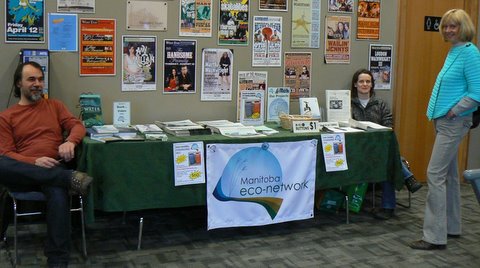
image of a table with information pamphlets and 2 people sitting at either end
The Manitoba Eco-Network took advantage of the opportunity to spread the word.

Thanks go to the Lake Friendly project, the Lake Winnipeg Foundation and the Arts for Water Project for bringing us this delightful afternoon.

The first ever Canada Water Week , March 14 to 22, 2011 is the inspiration behind one of Manitoba’s most unique celebrations of water.  The Healthy Rivers, Living Lakes Concert on Sunday March 20 at 2 P.M. at the West End Cultural Centre in Winnipeg  is the first time that musicians , artists, scientists and environmentalists have collaborated to draw attention to our beautiful lakes in Manitoba and in particular, to the need to better protect them.
Well known Manitoba performers including comedian Al Rae as MC, singer-songwriter Heather Bishop and musicians Sam Baardman and Susan Israel are so concerned about what is happening to Lake Winnipeg that they’re volunteering their talents and time to this concert. The songs, poetry, stories, and artistic displays are all dedicated to raising awareness about protecting our precious freshwater rivers and lakes.

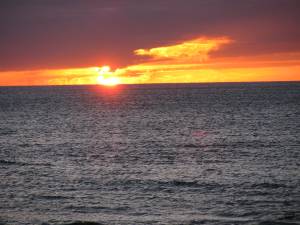
image of sun setting over water

sunset over the lake

For the first time,  Lake Friendly , Lake Winnipeg Foundation, and Arts for Water Project have joined forces to put together this celebration as part of the National Canada Water Week program.  “ Across Canada we are working to raise awareness of the need to do more to protect our precious freshwater and to build a wider understanding that  as individuals our everyday actions count because we all live on the lake ” explains Colleen Sklar, Executive Director of Lake Friendly. “In Manitoba we have Canada’s 6th great lake, Lake Winnipeg, and its going to take all of our efforts  to  protect the health of our lakes and rivers.   This concert is one more way to build public awareness and work with artist, musicians and poets to celebrate the beauty and importance of our shared waters. “
Bruce Smith, President of Lake Winnipeg Foundation, says “ We’re excited to bring the energy of all these talented musicians and artists to bear on the lake’s situation. This concert is a unique opportunity to attract more people to this cause and to educate them about solutions”.
I hope that the music and art at this concert will cause more people to pay attention to what is happening to our precious rivers and lakes. We all need to get involved in order to protect them now and for future generations.

Posted by: Vicki Burns | February 20, 2011

Beavers, Wetlands and Lake Winnipeg – Pesky Rodent or Eco-Hero?

I was delighted to open my Globe and Mail today to find this article, Our Rodent Saviour by Erin Anderssen with charming illustrations by Dushan Milic. Its all about the ecological benefits provided by beavers related to their dam building and the positives associated with that. As a person who got my start in environmental awareness because of my interest in animals and their welfare, I’ve often been dismayed at the bad rap given to beavers. In Manitoba I have been aware of several municipalities that actually put a bounty on beavers because of their dams creating flooding. I understand why we don’t want roads flooded and culverts blocked but instead of an all-out annihilation of the species, why not look at how to find a balance with beavers to allow them to contribute all of the positives they can.
The environmental benefits offered by beavers include raising the water table, increasing biodiversity, decreasing pollutants amongst others. In the Red River Valley where we’re consumed these days with fears of flooding, beaver dams can assist with slowing down the flow from tributaries, helping to reconstruct wetlands and clean some of the pollutants as they flow through the dams. Apparently one study of a river in Russia looked at the pollutants emanating from a cheese factory and what happened after the water had passed through nearby beaver dams. The water was almost as clean as it had been before the factory. Lake Winnipeg could certainly benefit from any pollutant cleansing natural action.

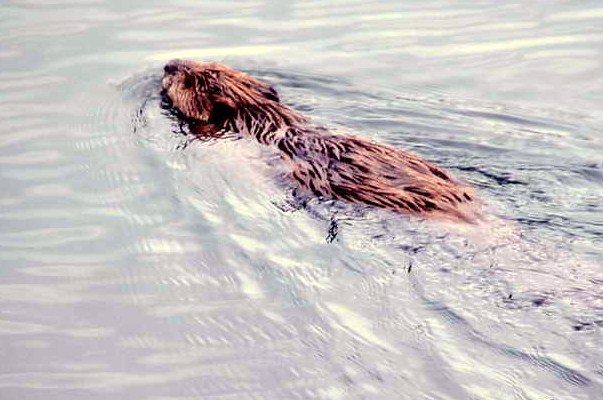
image of beaver swimming

Beaver swimming through stream, photo credit We For Animals

The subject of beavers and our reactions to them, reminds me of the folly of humans thinking that we can “control nature” rather than having the utmost respect for nature. Isn’t it becoming clearer to us that our very existence is reliant upon being able to live harmoniously with nature? I hope so.

A few weeks ago I attended the annual conference of the Red River Basin Commission and understandably, many of the presentations were focussed on the likelihood of another spring flood in the Red River Valley. One of the presentations that caught my attention was about the goal of decreasing the flow from tributaries to the Red River by 20%. This proposal is only being worked on in the American portion of the Red River Valley but it sounds like a very practical idea.

image of car flooded in front of house

Red River Flood 2009

Yesterday I read a related article by Laura Rance in the Winnipeg Free Press which is describing the work of the Deerwood Soil and Water Management Group who have worked in the Tobacco Creek Watershed for the past 26 years. This group of farmers have created a number of small dam structures to reduce the damage from flash floods and heavy rainfalls. These structures have actually reduced peak flows by 25 % and have saved the local municipalities millions of dollars in flood damage compensation. Not only is the water slowed down during flood events but its held longer on the land for irrigation purposes. Sounds like there are several good reasons to support this type of action across our landscapes.

Lake Winnipeg also suffers with each flood event that occurs because the fast flow of water across the landscape brings with it more phosphorus and nitrogen that feed the blue-green algae blooms. Any actions that can decrease flooding will benefit not only the multitude of people living within the floodplain but also the health of the lakes that receive the floodwaters.

Those of us working in the “water world” understand that we need to somehow shift the public’s attitudes from taking water for granted to treating it as a precious  life-giving resource. Last week people living in Regina had a very small taste of the threat of not enough safe clean water. There was a power outage at the water treatment plant and city officials had to issue pleas to the public to decrease their use of water from the tap. Luckily the problem was resolved in less than 24 hours but it was a wake-up call in some respects. The official’s pleas to decrease use did result in 18% decrease for that day.

Tap running dry

In North America, many people still treat water as though it is an unlimited, constantly available resource. Even though surveys show that the majority  understand the essential nature of water – we simply cannot live without safe clean water – our collective behaviour in using it, is inconsistent with the fact there is a limited supply in the world. Canadians’ per capita use of water is the second highest in the world, surpassed only by Americans. This really is a behaviour that can change if we can focus enough attention on the availability of many technologies to reduce volume of water used.
So how can we bring about that necessary change in our collective behaviour? Are we all going to have to live through our taps running dry at least once, before we stop wasting water?

Last fall’s weather bomb that hit Lake Winnipeg has generated a storm of public emotions and opinions. The tremendous winds that tore across the lake wreaked havoc along some shorelines, causing  property owners to lose yards of land and bringing the water’s edge dangerously close to dwellings. The property owners are looking for ways to protect their houses but those measures will impact the public beaches, which is raising a storm of protest from other community members.

image of eroding shoreline very close to house

Extreme erosion after weather bomb on Lake Winnipeg

Bruce Owen, a reporter for the Winnipeg Free Press, and a cottage owner for many years at Victoria Beach has summed up the community turmoil very well in this blog.
I think that what is happening at Victoria Beach is an example of what we are likely to see happening in many situations as we move towards implementing policies and practices that are more respectful of the natural world and therefore, building a more sustainable future for coming  generations. Grappling with the notion that we cannot control Nature and accepting the idea that everything we do has an impact on the natural world, is going to be a very big challenge for us. Change is very often painful and I think we need to be prepared to deal with some of the painful human emotions and conflicts that are bound to arise. The cost of avoiding it are becoming very high.
In relation to the Victoria Beach situation it seems prudent to consider all known impacts and options before moving ahead with man-made solutions.

Last week I had the opportunity to attend the annual conference of the MCDA( Manitoba Conservation Districts Association). It was well attended with several hundred people from all over the southern half of Manitoba. The Conservation Districts in Manitoba have been charged with the responsibility of developing and implementing integrated watershed management plans. They are doing much of the real “on the ground” work that needs to happen to in order to restore the health of our watersheds.

image of 3 children splashing in water

Kids playing in safe, clean water

Maude Barlow gave the opening key note address and she was riveting in her speech. She had just returned from the climate talks in Cancun and brought the unwelcome news that Canada had received all 3 of the “fossil” awards for standing in the way of a meaningful progress towards a climate change accord. She went on to heighten awareness of the need for Canada to adopt a national water policy. She praised the Conservation Districts for their “hands on” work in restoring the health of our watersheds. I find it impossible to listen to Maude without getting even more committed to the urgency of the work that we need to do to protect our precious water resources.  She provided a terrific start to the conference by establishing the important context within which we’re all working.
Over the next 2 days there were several good presentations from different conservation district managers talking about some of the progressive new ideas they’re working on. One of the most striking was from Ryan Canart of the Upper Assiniboine Conservation District talking about the concept of AgroForestry .  The last few presentations were from other groups ( Canon Envirothon Manitoba Eco-Network CIER) working on water issues, including our own Foundations in the Lake Winnipeg Watershed Initiative. All in all, it was a great opportunity to network and to learn about what’s going on around the province.


image of word "yuk' raked inot dired algae at the beach

Remnants of blue-green algae on Lake winnipeg Beach

Dr. James Byrne, from the University of Lethbridge, in association with several community and private foundations, has just released the documentary CHOKING LAKE WINNIPEG. The Winnipeg Foundation sponsored a premiere screening of the documentary at the IMAX theatre in Winnipeg to a full house last week. Judging by the feedback after the screening, I think it was well received and generated plenty of buzz.
The 25 minute video is full of easy to understand descriptions of what is causing the massive blue-green algae blooms in Lake Winnipeg and other water bodies across the Prairies. It also describes some of the solutions to the problems and makes the point that every one of us can be part of the solution. I think its an excellent resource for community groups to use to generate interest in the situation which is occurring in many water bodies across the Prairies. Even more important is that it can be used to generate discussion at the local level about what individuals and communities can do to restore the health of prairie lakes and ultimately Lake Winnipeg.
Community Foundations of Canada, as part of our Lake Winnipeg Watershed Initiative, has developed a “tool kit” to go along with the video to help groups to plan, advertise and coordinate a local water event. Its available to any group interested in promoting greater understanding of water issues and the solutions. So just contact me if you’d like to pursue using this.

Thank you to all of the foundations who made CHOKING LAKE WINNIPEG possible.

The Calgary Foundation,     The Edmonton Community Foundation,     Red Deer & District Community Foundation, Community Foundation of Medicine Hat and Southeastern Alberta
Battle River Community Foundation

The Banff Community Foundation  ,  The J.W.McConnell Family Foundation        The Winnipeg Foundation

The Thomas Sill Foundation

« Newer Posts - Older Posts »

Categories