Posted by: Vicki Burns | June 14, 2010

BP Oil Spill – Are We Getting the True Picture?

I was amazed to learn that BP has actually purchased search engine terms on Google and Yahoo in an effort to control what people will find when they research online the oil spill going on in the Gulf of Mexico. I’m not sure why I’m amazed because controlling the public’s access to information about a variety of situations from wars to government programs has been going on for some time. The concept of “putting a spin” on something seems to be a well accepted practice.

Sadly though, there is very little positive spin that even the most talented spin doctor could put on this environmental disaster. I’m struck by the number of people who have mentioned the BP oil spill in the Gulf of Mexico to me – many of whom have not indicated any concern over environmental issues in the past. Maybe that is the positive that will come from this tremendous fouling of waters – a wakeup call to all of us that we need to do a better job of protecting the natural world that sustains us.

One of the new things I’ve learned since being involved in water work is the tremendous value of wetlands in keeping our freshwater clean. I’ve heard scientists from Ducks Unlimited refer to wetlands as nature’s kidneys. They actually filter out much of the excess phosphorus and nitrogen that cause the blooms of toxic blue – green algae that are taking over many of our water bodies. The plant life, like cattails and bulrushes, that grow in wetlands take up nutrients as they grow. There are other very positive benefits that wetlands give to the natural world as well.

image of marsh with water in the background

Wetlands at Water's Edge

So if you were told that almost 70% of your kidney function had been lost I think you’d be very concerned. Alarmingly, this is what we’re learning about wetland loss across the Prairies. Almost 70 % of wetlands have been drained over the past few decades, in order to cultivate land or develop it for residential use. If we want to restore our waterways to better health, we’re going to have to repair much of that wetland loss. 

The R.M. of Dufferin in Manitoba has taken very positive steps in encouraging their landowners to leave wetlands in place or to return previously drained wetlands to their former state. They have committed $10,000 a year for the next 3 years to pay landowners to do this and the  LaSalle Redboine Conservation District has contributed an additional $5000 per year to the pot.

Fred Dunn, one of the councillors for Dufferin who pushed for this initiative, explained it to me another way “ We’re flood proofing to the east of us and drought proofing to the west by holding water in place for a longer time”. What a great example of a local government putting money into prevention!

I’d like to see more concrete actions like this from governments, municipal through to provincial to federal. Do you agree?

I’m often asked for examples of ways that community foundations can get involved in water related work. Here is a terrific example of a community foundation taking some initiative in getting their community together to think about the very real water issues they were facing.

image of water with forested mountains in the background

Beautiful Sunshine Coast Scene

The Sunshine Coast Community Foundation, a relatively new community foundation incorporated in 2003, decided to put alot of focus on the water issues facing their region of British Columbia. They partnered with a local environmental group, the Ruby Lake Lagoon Nature Reserve Society, to organize the 1st Sunshine Coast Water Summit in 2006. The local government district, the Sunshine Coast Regional District came on board with matching funds and the 2 day summit was held.
 
Don Basham, a board member of the Sunshine Coast Community Foundation, feels that being involved with putting on the Water Summit was very helpful for the foundation in terms of positioning them within the community. They were taking leadership on an issue which holds long term consequences for the health of their community. Being involved in the summit helped their foundation to make connections with a variety of people coming from all walks of life, who now support their community foundation. Ensuring clean, safe water now and for the future is a goal we can all support. Could your foundation help to convene such a Water Summit in your community?

Last week I was delighted to be invited to give a presentation to the Grades 7 to 12 students at St. Mary’s Academy on the topic of Water Conservation. They were holding a special assembly for all the upper grades and it was organized by the Green Team students at the school.

The Green Team had chosen to work on Water Issues this year and had prepared a terrific presentation and video on some of the most basic concerns regarding the availability of freshwater all over the world. They were selling reusable water bottles with their logo on it to encourage students to stop buying bottle water.

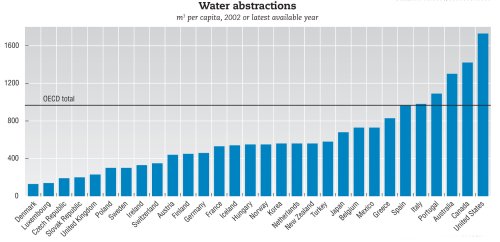
While preparing my presentation I came across some information which we as Canadians should not be very proud of – we rank 15th out of 16 peer countries in terms of our water consumption. The Conference Board of Canada has prepared some very useful information about this. I was pleased to find very helpful information about ways we can conserve water in many different websites including Natural Resources Canada and Go Blue – Get Involved.

image of water consumption ranking Canada as 15 out of 16 peer countries

Canada gets D grade for 2nd highest water consumption

The World Wildlife Fund is offering grants of up to $5000 to schools to encourage students to get involved in environmental projects including, including Water Conservation. The most encouraging thing though, is to see high school students, the Green Team at St. Mary’s Academy, who are so committed to promoting change. They are going to be tomorrow’s leaders and they are demonstrating passion and commitment to protecting water now and for the future.

Posted by: Vicki Burns | May 27, 2010

Biomimicry –Amazing Lessons from the Natural World

I was fortunate to have the opportunity to attend a presentation in Toronto at the ROM( Royal Ontario Museum) put on by the CEGN,Canadian Environmental Grantmakers Network. The speaker, Janine Benyus, is a natural sciences writer, who has been studying and promoting biomimicry for the last 20 years.

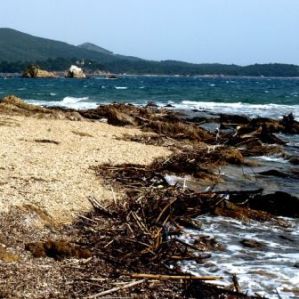
image of rough beach with sticks and rocks and waves in the distance

Rough Beach Trail

The basic idea is that we can learn so much from how things are done in the natural world, for example how sea shells are formed and why they don’t grow too big. It’s a principle that some engineers are researching to figure out how to apply it to the build up of scaling inside water pipes. Wouldn’t it be terrific to be able to use a natural process rather than toxic chemicals to keep our water pipes clear?

The Biomimicry Institute that Janine Benyus started, promotes learning from and then emulating natural forms, processes and ecosystems to create more sustainable and healthier human technologies. In her presentation she shared a multitude of examples that are both amazing and inspiring.

I’m definitely going to learn more about this work and how we can apply it to our water quality and quantity challenges. If you already know about some examples of biomimicry and its application to water concerns, please pass them on .

Posted by: Vicki Burns | May 21, 2010

Clean Safe Drinking Water – Do All Canadians Have it?

image of tap water going into a glass

Clean safe water from the tap to the glass

This past week there has been much in the news about the state of drinking water in Canada. The 10th anniversary of the Walkerton tragedy, in which 7 people died due to ecoli poisoning from their drinking water , has sparked interest in what progress has been made over the past decade.
I had no idea how many communities across our country are still without clean safe water coming from their taps. At last count, there were about 1776 boil water advisories across Canada according to a report published by Ecojustice and FLOW. In my home province, Manitoba, we currently have 86 boil water advisories according to the Manitoba Water Stewardship website. Do you know how many boil water advisories are in place in your province?
I also had no idea that we still don’t have national standards for drinking water. Surely having basic standards for clean, safe drinking water should be something that is applied across Canada. Do you agree?

I wonder how many of us just take for granted our safe drinking water. Maybe its time to pay more attention to this precious resource.

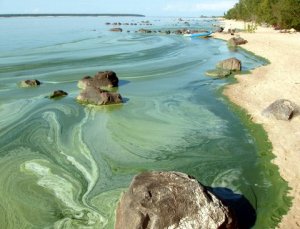
In our own back yards in Canada and around the world, there are massive blue-green algae blooms taking over many water bodies. The scientific term for it is eutrophication – an overload of nutrients (nitrogen and phosphorus).This overload  feeds the growth of algal blooms, many of which are blue green cyanobacteria that contain toxins dangerous to humans and animals. The excessive algal blooms cause a depletion of oxygen when they die and this in turn negatively affects the fish and other aquatic life that depend on oxygen for their survival.

image of blue-green algae on beach at Lake Winnipeg

Blue-green Algae on Beach at Lake Winnipeg

I find it interesting to realize that the very things leading to this problem, on their own, are not a problem. Phosphorus and nitrogen are very important elements, in fact we all need them to survive. Humans, animals, plants, everything that grows needs phosphorus and nitrogen. The other side of this is that we humans and animals excrete phosphorus and nitrogen in our waste. The problem is very simply that there is too much phosphorus and nitrogen getting into our streams, rivers and lakes.

In the case of Lake Winnipeg, the overload of nutrients  is coming from millions of sources throughout the almost 1 million sq. km. of its watershed. All of us humans (6.5 million) that live in the watershed; all the animals –  livestock, pets and wildlife; chemical fertilizers; waste from industrial plants and natural runoff from the land, we’re all part of the problem. This is why we are all going to have to share the responsibility of changing our habits in order to decrease the nutrient load to the lake.

It’s a huge challenge to stop the excess of nutrients getting into our water but it is possible. Are you willing to be part of the solution rather than being part of the problem?

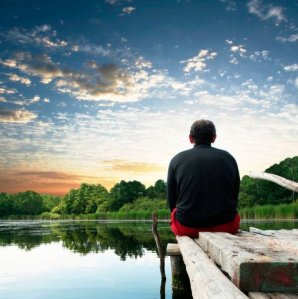
Image of man sitting on dock enjoying lake sunrise

Beautiful Lake Scene

 The Lake Winnipeg Foundation has joined up with 70 other environmental organizations around the world to promote the protection, restoration and rehabilitation of lakes and wetlands around the world. The Living Lakes Network International is a non-governmental network that was started by Global Nature Fund in Germany in1998.                                                                                           

The Lake Winnipeg Foundation has joined forces with Wildsight , an environmental group centred in British Columbia representing the Columbia Wetlands, to create the new Living Lakes Network Canada.

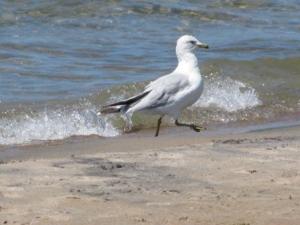
Image of seagull walking along the lake's shore

Seagull enjoying Lake Winnipeg beach

One of the main ideas of the Living Lakes Network is to encourage the sharing of ideas and positive experiences in restoring the health of our waterways. I’ve often thought that we don’t need to reinvent the wheel – why not learn from the experiences of others? 

The problems of toxic blue-green algae, otherwise known as hyper-eutrophication ( an overabundance of phosphorus and nitrogen) are occurring all over the world. They are the result of human activities and the only good news about that, is that we have the power to change our activities. I’ll be writing much about what we need to change in future blogs.
For now, I want to congratulate the Lake Winnipeg Foundation for taking an important step in helping us to learn from the positive experiences of others.

Posted by: Vicki Burns | May 13, 2010

Bottled Water – What’s All the Fuss About?

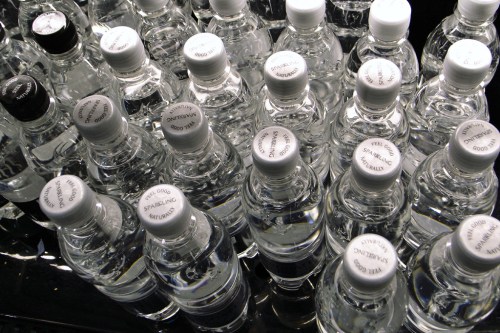
image of bottled water

On average bottled water costs 2000 times more than tap water.

We’ve probably all heard about different municipalities, schools, public buildings across the country that are taking action on banning bottled water in their facilities but do we really understand why?

Here is one of the most comprehensive and interesting short videos  The Story of Bottled Water ( www.storyofstuff.com/bottledwater/)  that explains it so well. Annie Leonard started with the Story of Stuff several years ago and now has released this 7 minute video that shows very clearly why we should stop buying bottled water for several reasons, not the least of which is the mountain of waste we’re creating.
 
I was recently at a meeting about water in Banff and someone suggested that Parks Canada should hand out re-usable water bottles with the park pass you buy upon entering the park. I think that would be a terrific message to give people about reusing water bottles and drinking the clean, safe water available from taps. What do you think?

Pass this message on to at least one more person and we’ll have helped to spread the word. In Canada we’re fortunate to have clean, safe drinking water coming out of many of our taps. Lets work to ensure that clean, safe water is available to everyone now and in the future.

Posted by: Vicki Burns | April 15, 2010

Prairie Water Problems – How You Can Help!

Welcome to my first blog posting about water problems across the Prairies and what we can do to fix them!

I’ve had the opportunity to travel through Manitoba, Saskatchewan and Alberta over the past two years learning about what is going on throughout the vast watershed of Lake Winnipeg (almost 1 million square kilometres). I’ve been both disheartened by what I’ve seen and encouraged at the same time.

Why – because there are serious concerns with both water quality and quantity that many people are unaware of.

Lake Winnipeg algae blooms

Algae blooms in the Lake Winnipeg Watershed

Tremendous toxic blue green algae blooms taking over many lakes; boil water advisories warning that the water is not safe to drink; and both droughts and floods occurring more frequently. On the positive side though, I’ve also learned about the numerous groups working on watershed protection and planning for the future [PDF]!

My perception is that there is a great need to raise awareness amongst the general public about these water problems and to deliver the message that we can all help to protect our precious water so that we have enough clean, safe water for now and for the future!

Here is a simple list of things that everyone can do to start to decrease pollution and to stop wasting water [PDF]. I hope that together we can build on that list with more ideas and examples of what anyone can do whether you’re an individual, foundation, business, or municipality!

Please contact me with any ideas or examples you have of good innovative projects related to water – both pollution prevention and water conservation.

« Newer Posts

Categories