Today is Day 80 of the 2011 Flood Season and there is no end in sight yet. Recent heavy rains in Saskatchewan have added so much water to the already water logged land that the Souris River is expected to top the historical record set in 1881 by 5 feet.  Over 10,000 residents of the city of Minot, North Dakota have had to evacuate and Manitoba towns, Melita, Souris and Wawanesa are on alert now. The images coming from the Minot flooding are truly devastating.
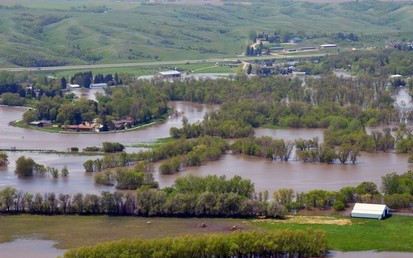
image of river overrunning its banks

Souris River Spilling Its Banks Near Minot, N.D.

Steve Ashton, Manitoba’s Emergency Measures Minister was quoted as saying, “Everything we’ve used to describe the flood so far has proven to be inadequate. Unprecedented is really an understatement at this point.”

Tremendous energy and financial resources must be committed just to deal with emergency response to help all those who are personally affected by the flood and to compensate those (like farmers) whose incomes will be affected for some time to come. It seems that it would be difficult to take a step back and look at future flood mitigation measures when the crisis is so real right now. I hope, though, that we are able to do just that.

There are ways to mitigate future flood risks by taking a more holistic view of water management and investing in some land management practices that could slow the flow of water over our land dramatically. Restoring wetlands may appear to be a costly investment now but the payoffs will be substantial over time, both in benefits to our water quality in rivers and lakes, as well as to our wallets, with decreased flood compensation costs. The time is now to start thinking about how we can prevent this degree of flooding in future years.  Some of that knowledge and expertise already exists so let’s get going on using it.

Posted by: Vicki Burns | June 21, 2011

MGEU Demonstrates Commitment to Saving Lake Winnipeg

The Manitoba Government Employees Union is taking practical and real action to show their commitment to restoring the health of Lake Winnipeg. They recently announced the creation of a graduate student scholarship fund to support research on Lake Winnipeg. The $20,000 commitment over 5 years will allow a student to conduct research using the Lake Winnipeg Research Consortium’s ship, the Namao, as a platform.


Image of Lake Friendly logo, pelican and fish jumping at lake


As well the MGEU has organized 3 Lunch and Learn Sessions where Colleen Sklar, Executive Director of Lake Friendly Initiative,will present information to members about how their everyday choices can make a difference to restoring the health of Lake Winnipeg and other water bodies. Our lakes and rivers are becoming overloaded with excess nutrients, phosphorus and nitrogen, and we need to spread the word that what we all do matters! Many people still don’t understand that much of what we put in our gardens, on our lawns and down our sinks can have negative effect on our waterways. Its choices about the products we use and the practices we employ in our everyday lives, that can start to make a difference. I particularly like The Lake Friendly message because it’s a concrete and easy way to get people involved in the solutions. Once people begin to understand that human actions are a major cause of the lake’s problems, we can motivate them to alter their actions whether it is their choice of cleaning products, lawn care, sewage treatment, agriculture methods or wetland protection.


Posted by: Vicki Burns | June 8, 2011

Save Lake Winnipeg Act on Manitoba Government Agenda


Last week the Manitoba government announced that they are putting forward a new piece of legislation called the Save Lake Winnipeg Act. Its part of their plan to reduce the phosphorus load to the lake by 50% to return to a pre-1990 state. The announcement of this plan is a result of a 5 year study that was just released by Dr. Peter Leavitt of the University of Regina.

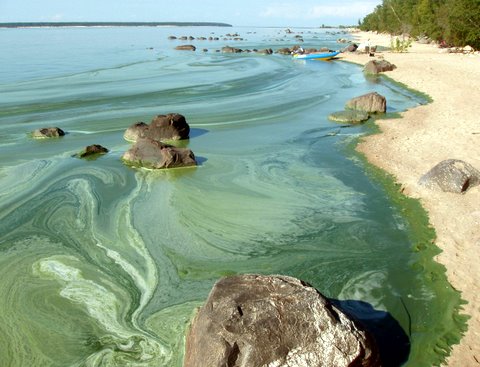
image of blue-green algae on beach at lake

Victoria Beach on Lake Winnipeg fouled with blue-green algae

Dr. Leavitt’s study focussed on the main sources of the excess phosphorus and nitrogen that are feeding the ever-growing blooms of blue-green algae on Lake Winnipeg. He points out that since 1990 the number of pigs raised in Manitoba has grown 5 fold while the intensification of the industry has resulted in 350 fewer hog farms but an 8 fold increase in the pig density per barn. Not surprisingly to me and many others who were concerned about the explosion in the hog industry in Manitoba, this has resulted in a big increase to the phosphorus and nitrogen getting into our waters. Another very important fact is that 47% of the phosphorus and 49% of the nitrogen are coming from within Manitoba’s own borders.
Dr. Leavitt’s study also noted that between 5 – 10 % of the phosphorus and nitrogen load to Lake Winnipeg is coming from the city of Winnipeg, which should add weight to the push for our city to get moving on bringing our wastewater treatment processes to the most progressive standards. If those of us living in the largest city closest to Lake Winnipeg cannot even claim that we’re doing the best job we can to decrease our contribution to this problem, how can we expect others to do more?
In conclusion, I’m gratified to see Dr. Leavitt’s report which spells out quite clearly some of the major factors contributing to Lake Winnipeg’s blue-green algae problem. I’m also pleased that the Manitoba government is starting to express stronger leadership towards solving this problem. The bottom line though, is that all of us can do a lot more to learn about how to protect our precious freshwater. Restoring the health of Lake Winnipeg and its watershed is going to taking action from everyone.

Posted by: Vicki Burns | May 30, 2011

Walk for Water Students Learn About Manitoba Water Issues

Today Colleen Sklar, Executive Director of Lake Friendly, and I gave a joint presentation to the Grade 6 to 8 students at Edmund Partridge School in Winnipeg. The students were holding a special assembly devoted to Water as they were preparing to go on their fundraising Walk For Water. This campaign is aimed at raising awareness and money for a school in Cameroon in Africa.

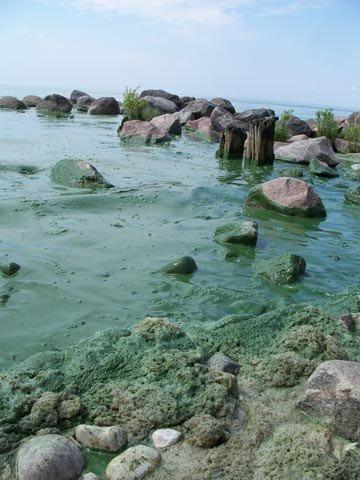
image of slime covered rocks

Blue green algae slimes rocks on Lake Winnipeg

The teachers at Edmund Partridge thought it would be helpful to bring a local perspective to the topic of water which resulted in us being there to talk about what is happening to Lake Winnipeg and in many rural communities throughout Manitoba. As we were preparing for this presentation we came across a few facts that I found quite striking:
• All the freshwater we now have on earth is all that there ever has been and ever will be. In other words, it is a finite supply.
 • We may be drinking the same water now that dinosaurs drank millions of years ago.
• More people in the world have cell phones than have access to clean, safe water.
However to bring it to a more local level, we talked about the difficulties facing thousands of people living in First Nation communities in northern Manitoba who do not have running water in their homes. We also talked about the many people in rural Manitoba who rely on well water for their drinking water and the fact that many of those wells have been contaminated because of the extensive flooding this year. Finally we spoke of the extreme eutrophication of Lake Winnipeg with massive blue-green algae blooms.
The best part though, was the message that Colleen and Lake Friendly bring – What You Do Matters! There are numerous ways we can all be part of the solution to the lake’s problems through the products we use, and our daily practices around water use. It was really quite energizing to speak to 300 students and think that even a few of them would go home and discuss some of these ideas with their parents.

I just read a very interesting article that links the tremendous loss of wetlands across the Prairies to the more frequent floods we’re seeing in Manitoba. We’re hopefully getting near the end of this year’s flood, although there are still some tense times ahead for communities near Lake Manitoba and some 3500 people have had to evacuate.
There is no doubt that the heavy snowfall this past winter, along with the water logged ground from last fall, are a major part of the reason that we’re experiencing such significant flooding along both the Red River and the Assiniboine River. But if we had not drained almost 70% of the wetlands across the Prairies over the last century, we would have had the benefit of their soaking up a lot of that water, similar to the way sponges function. I’ve now heard wetlands described both as “nature’s kidneys” and as “sponges”. Ducks Unlimited has done some very interesting research in the Broughton Creek watershed that demonstrates the degree of wetland loss over the past 40 years and spells out how much that contributes to run off from that area. They state that if we continue to drain the wetlands in that area, the total run-off could triple( total water draining downstream) and the peak discharge could double( high water volumes).
So, although I can understand why we’re  hearing  talk of the need for more drainage, it is just the opposite that we really need to prevent worse flooding in the future. At this point we have no idea how much this year’s flood mitigation and compensation are going to cost us but I hope that we can convince government to also invest a healthy chunk of money into retaining and even restoring some of our wetlands. That really would be a good investment for the future.
The Red River Basin Commission is focussing on flood solutions and I’m sure retaining water on the land is a big part of that solution. I’ll be blogging about their work in the near future.

image of colourful drawing with water, fish, bird and sun rising

Lake Friendly logo

image of EcoLogo
EcoLogo Certification

I came across this piece of news today that tweaked my interest and reminded me of the hidden costs associated with some of our actions to secure the cheapest price for everyday products. The news item is reporting that a city councillor in Winnipeg, Grant Nordman, is advocating that the city adopt a policy of purchasing EcoLogo Certified cleaning products for all its facilities. The EcoLogo products are Lake Friendly, which means they don’t contain phosphorus and other harmful chemicals that get into our wastewater and eventually into Lake Winnipeg. I applaud Mr. Nordman for his efforts to encourage the city to do the “right” thing.
On the other side of the argument though, Colin Craig of the Canadian Taxpayers Federation is expressing concern that purchasing EcoLogo Certified products may cost more and tax payers won’t be happy with that. The problem with that argument is that at some point, through our municipal, provincial and federal taxes we are all going to be paying for a variety of measures that are going to be required to “clean up” the lake.  Lake Winnipeg is unfortunately gaining an international reputation for being the most eutrophic large lake in the world. It is the 10th largest lake on the planet and is now garnering attention for the wrong reasons.
I think this is a great example of how our short term thinking can create far more costly conditions down the road. Adopting the “greener” practice now by buying the Lake Friendly products, is ultimately part of the solution for restoring the health of Lake Winnipeg. I think Lake Winnipeg is worth it. Do you?

Further to the blog I posted yesterday about video of the flooding in North Dakota along the US portion of the Red River, here are some equally disturbing images taken by Joe Bryska, photographer with the Winnipeg Free Press. Joe’s pictures are taken along the Red River from Morris up to St. Jean Baptiste. Once again it looks like most homes are protected from the flooding but the farmland has become a sea.
Southern Manitoba has a high rate of intensive hog operations, many of which would use lagoons to store their liquid manure. I’m not sure how many of these lagoons may have been breached but looking at these pictures certainly makes one think that it’s a good possibility it has happened. Kerry Freek of Water Canada has posted a blog today mentioning that she has requested an article for their May/June issue from Terry Hanley, Director of Science, Information and Monitoring at the Saskatchewan Watershed Authority. He’ll be discussing the risks flooding poses to water quality and particularly to users of private wells.
Once again, it strikes me that the majority of Manitobans who live within the city of Winnipeg are well protected from the immediate effects of this flooding, but over the long term our lakes will bear the consequences of the increased nutrients and pollutants flowing off the land.

I just received this link from the Red River Basin Commission. It’s a video on You Tube taken all along the Red River from Fargo-Moorhead north. It doesn’t extend across the border to Canada but the water will ultimately flow up here, along with all the excess nutrients and other pollutants that are bound to be in it. The images show a sea of water across the landscape. Its hard to imagine the mess that will be left once the water subsides.
In Manitoba, this is being called the 2nd worst flood in 150 years due to the extent of overland flooding. 30 municipalities have declared states of emergencies , 80 provincial roads are affected and 500 municipal roads are closed. Thankfully only a handful of homes have been flooded but the damage is extensive in many other ways. So make sure to check out the video – a picture is worth a thousand words.

image of house surrounded by flood waters

Flooding in Manitoba

Many of us who live on the Prairies have been watching the rising waters on our creeks and rivers with great trepidation. Some of the flooding concerns were starting  a month ago in southern Alberta with an early and fast spring melt as well as a snow pack that was 2 ½ times the highest ever recorded in Medicine Hat. The waters are now travelling east across Saskatchewan and north up through North Dakota and into Manitoba.
Today I spoke to staff from the Red River Basin Commission in Fargo who reported that the Red River has crested in that city a few days ago and fortunately it seems that the flood mitigation measures have been successful preventing any significant damage within the urban setting. However it’s a different story out on the landscape with many farms completely flooded and numerous roads closed. The major Interstate Highway I-29 linking Fargo with communities to the north, including Winnipeg has been closed for about 30 miles. In Canada, the major national highway, the TransCanada, has been closed between Regina and Grenfell. There are numerous roads within Manitoba that are closed due to flooding. Check out this map to get an idea of how widespread it is.
All these road closures prompted me to think about what we have been able to do in terms of mitigating negative effects of floods and more importantly, what we cannot do. The road closures create a picture of miles of land underwater and the next image is what runs off that land with the flood water. The runoff will be loaded with phosphorus and nitrogen that are the major culprits in the blooming of blue-green algae in our lakes. So, I’m grateful that we have been able to decrease the suffering of many people during this flood event but our lakes will certainly bear the consequences.

In the 3 years that I’ve been working on water issues, I’ve heard repeatedly that we need to develop a national water policy which includes consistent standards, objectives and harmonized approaches to our water quantity and quality issues across Canada. Recently I’ve become aware of a very helpful report completed by Émilie Lagacé,  Shared Water-One Framework.

Water – essential for all life

Émilie is a Walter and Duncan Gordon Fellow who was mentored by FLOW. She  studied at Oxford University  and a couple of years later returned to work in Europe at the time that the E.U.’s Water Framework Directive was being transposed into national legislations across the E.U. She was well positioned to interview many stakeholders in Europe and then to continue that process in Canada. Her report explains what the Water Framework Directive is all about and gives some excellent reasons why Canada would do well to emulate this approach.
I was very interested to learn how the European Union representing 27 different countries with numerous different languages and cultures could manage to come to agreement on water policies and then to actually agree on how to harmonize their approaches. Apparently, the leadership of the European Parliament was known to be very progressive and very “green”. Around 2000 when the Water Framework Directive was put together there was a shift from policies that focussed on human needs to policies that targeted protection of the water environment. There were some real champions in key positions who understood that protecting the environment would ultimately protect the human needs.
The E.U.’s Water Framework Directive includes some very meaningful consequences for not meeting the agreed upon objectives. One example of this is the European Court of Justice imposing a fine of 58 million Euros on France for not complying with fisheries regulations. That speaks volumes to me – they really are serious about these regulations. I’m not aware of anything remotely close to that in Canada.
It seems to me that although we can’t copy everything in the Water Framework Directive, we can use it as a working model to create something similar in Canada. We don’t need to re-invent the wheel. So how can we bring about a national water strategy and policy in Canada? What are the barriers and who needs to be involved to make this happen?

« Newer Posts - Older Posts »

Categories