Posted by: Vicki Burns | November 24, 2011

The City of Winnipeg Continuing to Pollute Lake Winnipeg

Wouldn’t you think that the city of Winnipeg being the closest large city to Lake Winnipeg and having the most residents who enjoy the lake, would make sure to do whatever it could to decrease the problem of too much phosphorus and nitrogen getting into the lake? That phosphorus and nitrogen is what is feeding the blue-green algae blooms that have become so huge they can now be seen from outer space. Until a few years ago, I would have assumed that Winnipeg was doing the best job possible but I would have been wrong.
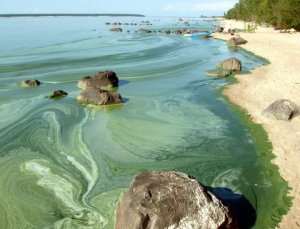
Blue-green algae on shores of Lake Winnipeg


 In today’s Winnipeg Free Press there is an article which clearly articulates how poorly Winnipeg rates in comparison to other cities and industrial facilities across the country in terms of phosphorus being discharged into our waterways. We have the distinction of being the fourth worst phosphorus dumper in the country. Along with that distinction, our province is also home to what is considered the “sickest lake” in the world, Lake Winnipeg. This is not a coincidence. These two are connected.

From my perspective, as an advocate for the health of the lake, it is extremely frustrating that the city of Winnipeg has not demonstrated any leadership in terms of making the necessary investments in upgrading our wastewater treatment facilities. How can we expect others who are much further from the lake to do the right thing when we are not willing to lead the way.  The problems we see in Lake Winnipeg are going to get worse and those of us who live in Winnipeg bear some responsibility for not insisting that our city do the right thing as soon as possible. Everyone who lives in the Lake Winnipeg watershed (almost 1 million square kilometers) has a part to play in cleaning up our lakes but we, the citizens of Winnipeg, have the greatest part to play. Let’s get going to do our part so we can push others to do theirs.

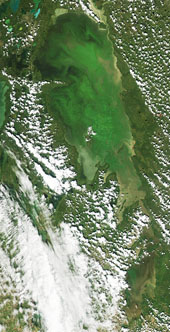
I was dismayed to see news about the deteriorating state of Lake Erie due to massive blue-green algae blooms. According to this news piece the algae blooms are threatening a huge fishing industry as well as the future of communities along the shores of the lake. The conditions they are describing in Lake Erie sound very similar to what we have here in Manitoba – blue-green algae blooms so large they can be seen from space. However in Manitoba we don’t often hear this kind of news piece, perhaps because there are not nearly as many people living on the shores of the lake and the huge blooms often occur so late in the season that not many people actually see them. The threats posed by these toxic blooms are just as serious in our part of the world as they are in Lake Erie. Maybe we can learn something from the approach they take there to solve this problem.

Satellite image of massive blue-green algae Lake Erie

I just learned about a very unique project, the Water and Environmental Hub (WEHUB), that makes water data much easier to access. It is based on an open source web platform that allows users to download, analyze, model and make use of water and environmental information. It could really facilitate the sharing of information without the hassle that currently goes with trying to access data from various departments, universities, etc. Alex Joseph, the Executive Director of WEHUB, explains that there is currently no Google for water data and the WEHUB is, in a way, trying to make access to this data as easy as “googling” it.

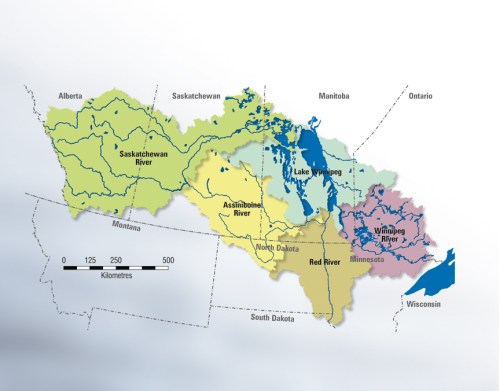
map of the Lake Winnipeg watershed outlining the different rivr basins which ar part of it

Lake Winnipeg Watershed - courtesy of Partners for the Saskatchewan River Basin

This concept seems so appropriate to be applied to water data because when you think about water, you have to realize that it is crossing so many man-made political boundaries. Each jurisdiction has their own particular way of collecting and recording data but the information gleaned from this data has relevance across all of these boundaries. As we know in Manitoba, the problems that are besieging Lake Winnipeg, are the cumulative result of water that has flowed throughout the watershed from The Rocky Mountains across Alberta, Saskatchewan and into Manitoba. From the south the water is flowing in the Red River starting in South Dakota and moving through North Dakota into Manitoba. From the east, the water starts almost at Lake Superior and moves through Ontario and Minnesota into Manitoba. That makes a lot of political boundaries for Lake Winnipeg’s water to cross.
It seems to me that it makes tremendous sense to use a system that will allow all those people working on and researching water issues, to have the easiest access to all the data available. I think the challenge will be to encourage everyone to use this web platform by sharing their own data and making use of data uploaded by others. It may require a letting go of “turf” and a genuine recognition of the value and synergies of collaborative efforts.

In the last few days I’ve spoken with a couple of people about severe algae blooms in several locations in Manitoba and northwestern Ontario this fall. The unseasonably warm temperatures we enjoyed in September and early October was great for many outdoor activities but it was also great for encouraging the blue-green algae to bloom.

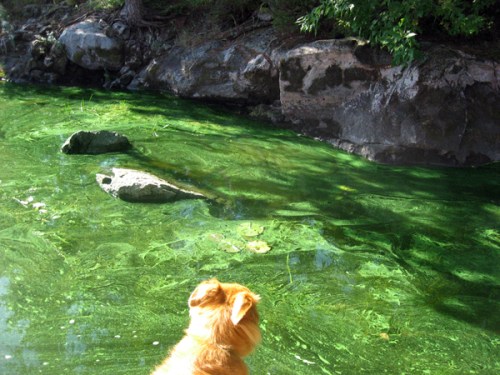
image of dog looking at water filled with blue-green algae

Blue-green algae at Minaki, Sept. 2011 photo courtesy of Todd Sellers

The Lake of the Woods Water Sustainability Foundation (LWWSF) recently published a Phosphorus Budget Study which details some interesting facts about water quality issues in Lake of the Woods and our warm fall is consistent with one of the most interesting facts they’ve presented.  According to their data, the Lake of the Woods now sees on average, one month longer ice free days throughout the year. In general the ice is freezing up 2 weeks later than it used to 40 years ago and thaws 2 weeks earlier. Todd Sellers, the Executive Director of the LWWSF, says this is great news for people who want to enjoy being on the water at the lake but the downside is that it offers a longer growing season for the algae. As Todd puts it, climate change is a real factor in the growing concerns about blue-green algae.
Robert T. Kristjanson, a fisher from Gimli Manitoba, was one of the other people who described some very big concerns with blue-green algae on Lake Winnipeg this fall. He and other members of the fishing industry encountered very thick algae near Grindstone on Lake Winnipeg.  Robert described it as “the worst he’s ever seen – it was like a wall clogging their nets so that the fish wouldn’t go near them.”It’s frustrating for Robert that the only time the algae makes news is when it washes up on busy beaches. He and other fishers often encounter it out in the middle of the lake where not many people will see it.
As I mentioned in a previous blog this summer, blue-green algae is becoming more of a problem in many areas around the world. We know that decreasing the excess nutrients of phosphorus and nitrogen getting into our waters is the solution and we also know how to accomplish this. What’s missing are the financial resources and the political will to make it happen.

Here is an inspiring story about a farmer, Bruce Tiffany, in Minnesota whose attitude is “If you won’t swim in it, you can do better”. He is referring to the run-off from his land. He is employing a number of different practices to slow and filter the water that falls on his land, some of which eventually runs off into the local streams.
Bruce’s efforts are partly in response to new information that is tying agricultural practices to dead zones in the Gulf of Mexico due to excess nitrates flowing down the Mississippi River. It’s not only agricultural practices but what is coming from towns and cities that is contributing to the problem and Minnesotans are looking at a variety of ways to change this.
Ground Level – Cleaning Minnesota’s Water is a website that is dedicated to telling individual stories of various projects that are going on to better manage the excess of water, sediments and nutrients that are affecting Minnesota and then downstream jurisdictions. It’s full of interesting examples.

image of Lake winnipeg taken from space

Recent satellite image of Lake Winnipeg showing huge blue-green algae bloom, courtesy of the LWRC

In Manitoba we’re in the midst of a very public dispute between hog producers and some other types of farmers and the government over the issue of who is to blame for the excess nutrients getting into Lake Winnipeg and other water bodies. Once again Lake Winnipeg, the 10th largest freshwater lake in the world, has a very large blue-green algae bloom covering much of the north basin of the lake. It’s too bad that finger pointing about blame is taking all the attention here, instead of everyone, rural or urban, doing their part to fix this problem.

Satellite image of Lake Winnipeg with blue-green algae bloom in north,photo from the Lake Winnipeg Research Consortium

Today I was doing some research about how common blue-green algae is this summer. Instead of just “Googling” Canada as I often do, I left it wide-open putting blue-green algae 2011 in the search box. I was fascinated and dismayed to see reports of it, literally, around the world. From the State of Victoria in Australia to the UK and on up to the Baltic Sea in northern Europe and throughout North America, almost from coast to coast it is really blooming.
There are several American states including Oregon, Indiana, Oklahoma, Vermont, Kansas and Florida that have issued warnings to the public about staying out of waters that have signs of blue-green algae. In Kansas, there have been 3 dog deaths recently, one of which is confirmed as a result of toxic blue-green algae and the other 2 are suspected. There have also been 17 cases of human illness this year in Kansas that are suspected to be related to exposure to blue-green algae although it is not yet conclusive.
In Canada, there have been warnings about blue-green algae blooms in almost every province this summer. In my province of Manitoba, Lake Winnipeg, which often has massive blooms does have a large bloom in the north basin of the lake as evidenced by this satellite image but not much in the south basin which is where most cottagers locate. However there have been Algae Advisories in place on several smaller lakes in Manitoba including Falcon Lake, Pelican Lake, Killarney Lake and Rock Lake.
So this has made me realize that the challenges we face in the Lake Winnipeg watershed are shared by hundreds of other jurisdictions. Too much phosphorus and nitrogen getting into our waterways is causing problems all over the world. With this many countries suffering the negative environmental and human health effects of an overload of blue-green algae, I hope our collective efforts will push forward the changes that we all need to make.

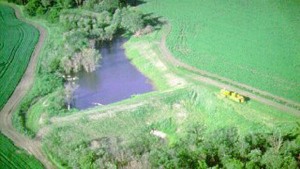
Deerwood Dam South Tobacco Creek

Today we received the latest estimates of this year’s flood costs – $632 million for fighting the flood and compensating those who had suffered damages related to it. Imagine what the total costs would be if you added in Saskatchewan and North Dakota’s bills. Manitobans are hoping to recover $478 million of those costs from the federal government but any way you look at it, these costs are covered by our taxes and each one of us who pays taxes should be paying attention to this.
Given what scientists are telling us about changing climate patterns, we can expect to see floods of this nature much more frequently in the future as the severity of storms increases the amount of precipitation that is dropped at any one time. To some this might seem like a hopeless scenario but there is something we can do about it. We can immediately begin work on a variety of measures that will hold water on the land longer whether it be wetland restoration or preservation ; waffling systems such as are being developed in the Red River Basin; a series of small dams similar to what’s being going on in the Tobacco Creek watershed. There are a number of ways to increase water retention on the land and given the extreme dryness we’ve experienced this summer immediately following the flood, there are several good reasons to do this.
The big challenge will be to persuade governments to invest in this type of flood mitigation. At a time when we’re trying to decrease deficits and bring back balanced budgets how can we spend more to compensate landowners for some of these water retention methods that will need to occur on private land? My thought is that we can’t afford not to make these investments now. Otherwise our flood costs in future years may really bankrupt us!

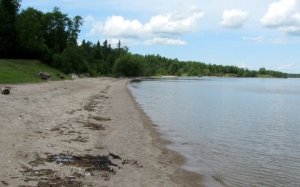
image of beach on lake

Ross Bailey and neighbours’ beach near Gimli

I attended the last of three public meetings at Victoria Beach on Monday night and was so impressed with the calibre of presentations from the twenty-one members of the public. The presentations were part of a public consultation on the issue of shoreline erosion and what should be done about it. An advisory committee has been set up to produce a report to the RM Council at Victoria Beach and to allow public participation in this heated issue.
The tone of the meeting was vastly different from the first meeting I attended on this issue last January. There was much more respect and a clear desire for a mutually beneficial solution. There were several themes that ran through many of the presentations, the first of which was recognition of the spiritual, aesthetic and historic connection that many people have to the beaches at Victoria Beach. So many people have been part of the Victoria Beach community for several generations and the beaches there are a significant part of those experiences. The second theme that seemed to resonate throughout was a feeling that the Hydro regulation of the lake was keeping it at heights that exacerbated the erosion. I don’t have enough knowledge of that issue to comment in an intelligent manner but with the upcoming Clean Environment Commission hearings on regulation of the lake, I hope we are able to acquire more unbiased information.

Ross Bailey’s neighbour who didn’t use shoreline technique, erosion from weather bomb in Oct. 2010

Two weeks ago, I spent an afternoon touring Lake Winnipeg shores on the west side of the lake around Gimli. Ross Bailey, a member of the Shoreline Erosion Technical Advisory Committee, wanted to show me the unique approach he had taken to shoreline issues at his own home twenty-five years ago. His approach has resulted in he and his neighbours, who’ve followed suit, having a beautiful beach and no erosion issues. However it requires a real shift in attitudes away from saving every foot of land towards understanding the natural lake processes and working with them. It may not be applicable to every situation but I think it merits consideration.
In the end, I am much more aware now of the natural rate of erosion for Lake Winnipeg shores and the inevitability of nature’s powers. It seems that we should keep this in mind to ensure that any future building is well back from the shores.

Posted by: Vicki Burns | July 25, 2011

Recognition Growing that Wetland Drainage Adds to Flooding

Over the last 4 months we have seen unprecedented flooding in Manitoba, Saskatchewan, North Dakota and south along the Mississippi River. In Manitoba the river levels have stabilized and the flooding occurring along the rivers has now diminished but there is still significant concern in our Interlake region and along the south basin shores of Lake Manitoba and Lake Winnipeg. The community of Lake St. Martin First Nation have been out of their homes for several months now and there are serious talks underway about the community relocating permanently.  The costs associated with flood damage restitution have still not been fully added up but it is in the hundreds of millions for this year alone.

image of marsh surrounded by trees and plant growth

Healthy marsh

I’m glad to see more recognition that this year’s flood was exacerbated by man- made actions, specifically the drainage of 70% of our wetlands across the Prairies. Ducks Unlimited has produced a very simple , short video that explains in laymen’s terms what damage comes from draining so many of our wetlands. Its worth the few minutes it takes to watch it, to give yourself a clear understanding of why we need to rectify this situation as soon as we can.
This op-ed piece appeared in one of Manitoba’s prime rural papers and its is also encouraging in terms of the writer’s understanding and explanation of what has caused such significant flooding this year.
The bottom line is that we all need to understand and pay attention to these wetland issues because even if you’re not in a flooded area, you’re still going to be paying for the damages caused by the flooding not to mention suffering the effects of the increased greenhouse gas emissions that accompany wetland loss.

Posted by: Vicki Burns | July 6, 2011

State of Lake Winnipeg Report Holds No Surprises

The Province of Manitoba and Environment Canada issued a State of Lake Winnipeg Report which is reporting on conditions on the lake between 1999 and 2007. Condensed highlights are available here. It is helpful to get a comprehensive report on the issues affecting the lake including algal blooms, invasive species, and climate change.  There does not seem to be any dramatic news included in this report and perhaps that is because it is reporting on data from 4 years ago. It does make one wonder why it would take 4 years to collate and analyze the data.

The most important message, I think, is that the blue-green algae blooms are dominated by cyanobacteria which contains a toxin, microcystin-LR , that is harmful to humans and animals.

image of blue-green algae covering rocks at beach

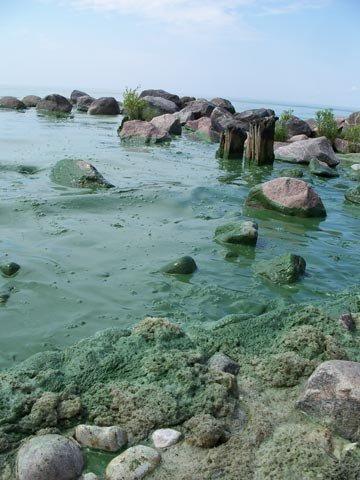
Blue-Green algae slimes rocks at Lake Winnipeg

Along with this report the Province of Manitoba is proposing water quality standards for municipal and industrial wastewater treatment. The standards are addressing the amount of phosphorus and nitrogen, in some circumstances, that remains in the wastewater once it is discharged to local waterways. They are seeking feedback on these standards by Aug. 4, 2011.

I understand that the province collects data each year on the amount of phosphorus and nitrogen entering Lake Winnipeg from the various rivers that supply the lake. I think it would be helpful if we could see those numbers every year so that we can understand, in measurable terms, whether the problems associated with the blue-green algae blooms are getting better or worse. I hope that we can access this data on a more timely basis in the future.

« Newer Posts - Older Posts »

Categories