Erik Friesen, a first year university student from Winnipeg, is putting his muscles to work on a cycling endurance test to raise money for the Lake Winnipeg Research Consortium Scholarship. He is going to ride from the headwaters of the Red River at Breckenridge, Minnesota all the way to the Forks in Winnipeg. Its a distance of 450 km and he’s planning to do it in one day! That seems like a real challenge to me but when I mention this to Erik, he just grins and says it’s for a good cause.
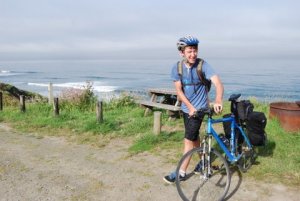
image of young man beside bike along water's edge

Erik Friesen on last year’s bike tour

All the proceeds are going directly into a fund that provides scholarships to Graduate students doing research on the Lake Winnipeg Watershed.  If you would like some more information on it you can visit Erik’s Facebook page.

If you would like to make a donation, you can write a cheque to: Lake Winnipeg Research Consortium, 62-2nd Ave.,P.O. Box 1289    Gimli, MB  R0C 1B0 . Mark it “The Water Cycle” and a tax receipt will be issued.

Anyone who donates can get a chance to win a day trip on the LWRC research ship, the Namao. The LWRC is working on encouraging more coordination and research on Lake Winnipeg so their scholarship fund is a terrific way to get graduate students paying attention to our great lake.

I asked Erik what motivated him to do this Water Cycle fundraiser and he answered simply that he is interested in doing whatever he can to preserve this great lake. He has spent time at both Grand Beach and Victoria Beach for many summers and is all too aware of the “horrible green sludge” (blue-green algae) that washes up on those beaches every August. I’m impressed and inspired by Erik’s personal commitment and effort to help Lake Winnipeg. I hope he gets lots of support for his Water Cycle Fundraiser!

Yesterday I attended the Yinka Dene Alliance Freedom rally at the Forks in Winnipeg. Its all about a group of First Nations from B.C. drawing attention to their move to stop the Enbridge pipeline being built across their traditional lands in B.C. They are concerned about the devastating effects an oil spill could have on their lands and waters. A group of 40 people are travelling by train across the country to Toronto to make their case at the Enbridge AGM.image of women holding banner, No Pipelines Without Consent

Several of the speakers at the rally referred to their desire to protect the land and water for the children and grandchildren of the next 7 generations. There were representatives of the grandmothers’ council in Manitoba and their words were impassioned and straightforward. As a grandmother myself, I relate strongly to the basic idea of wanting to protect the natural world for many reasons, not the least of which is our responsibility to future generations. Then I think about how we can accomplish this if we’re still so reliant on fossil fuels, which is driving the market for the tar sands product that would travel through the Enbridge pipeline.

This morning I opened the Globe and Mail to see an article about Denmark and how they have decreased their GHG by 13% since 1990 while we in North America have increased ours on average by 30%. Although they now provide 20% of their energy needs by wind power, the remaining 80% is coming from coal burning plants. Even so, they’ve decreased their  GHG emissions by shrinking energy needs through various energy conservation measures. They’ve increased the cost of energy to such an extent that consumers are driven by basic economics to ride bikes instead of driving, for example. It struck me that the basic idea of trying to decrease our energy use has not really taken off yet in North America. Maybe that is where we should be putting much more of our attention and efforts. What do you think?

Last night I attended the annual meeting of the Lake Winnipeg Foundation. As often happens, I found out some very interesting information during the informal part of the evening and thought it was worth sharing. Rick Gamble, Mayor of Dunnottar, who is on the board of the East Interlake Conservation District (EICD), told me about a new project they are undertaking in their area.

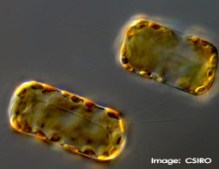
Algae Cells – Growing Algae website

Essentially it is the idea of deliberately growing algae in ponds on agricultural land and then harvesting the algae to use in several ways including fertilizer and bio-fuels. There are several benefits to this concept starting with holding water on the land as a flood mitigation measure. The algae growth in the ponds would take up some of the excess nutrients that are fuelling the excessive algae growth in lakes and the harvesting it would allow recapture of the valuable nutrient, phosphorus, which is essential for growing crops.

Armand Belanger, manager of the EICD, told me that they have over 20 farmers interested in pursuing alternative land use practices that will help them to manage their often wet fields, in ways that will produce some economic benefits. Armand described the deliberate growing and harvesting of algae as an example of a “bio-economical crop”.  It’s encouraging to learn of these innovative ideas that will be so essential if we want to decrease the traditional approach of drainage. Who can blame farmers for wanting to drain their land in order to plant crops? But if they can make money by holding water on their land and growing different types of crops, it will benefit not only their bottom line, but the surrounding environment and ultimately, the lake. It’s a win-win solution that I hope takes off.

Living Lakes Canada and the Lake Winnipeg Foundation are hosting a conference in May, 2012 to bring together lake stewardship groups across the country to help the world’s most eutrophic large lake, Lake Winnipeg. The title of having the most eutrophic large lake in the world is not something that we Manitobans are proud of but we are pleased that we have these organizations helping to bring attention and solutions to the problems of massive blue-green algae blooms that are plaguing our lake and many others.

For those of you not familiar with the term Eutrophication here is a definition:(Life Sciences & Allied Applications / Environmental Science) a process by which pollution from such sources as sewage effluent or leachate from fertilized fields causes a lake, pond, or fen to become overrich in organic and mineral nutrients, so that algae and cyanobacteria grow rapidly and deplete the oxygen supply often causing a die-off of other organisms.

The basic message is that its very threatening to the health of the entire aquatic eco-system as well as the humans and animals that use the lake if it becomes too eutrophic.

The Living Lakes Canada and Red Zone 111 Community Forum runs from May 22-24 and brings together a host of interesting speakers. Much of the focus will be on Climate Change and its impacts on the lake. It’s a great opportunity to learn more about what is happening to Lake Winnipeg and how we can reverse the unhealthy trend we’ve seen over the past decade. Check out the agenda and registration package for more details.

Posted by: Vicki Burns | April 4, 2012

Surface Water Management – Who Should Pay?

Yesterday I attended a day of discussions on the development of a Surface Water Management Strategy for Manitoba. It was put on the by Manitoba government, Conservation and Water Stewardship Department. There were representatives of environmental groups, agricultural industries, academics, scientists, municipal authorities and conservation districts. It is the beginning of a province–wide consultation on the many issues that would be involved in developing a comprehensive Surface Water Management Strategy. Those issues centre around drainage and flood prevention measures but have important implications for issues such as the eutrophication of our lakes, protection of drinking water and drought mitigation.

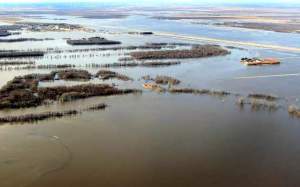
image of flloded land taken from the air

2011 Red River Flood - image by Joe Bryska

The province of Manitoba is still dealing with the bill of almost $1 billion as a result of last year’s flood. One of the presentations at the meeting yesterday was from Dr. Danny Blair, a professor in the Geography Department from the University of Winnipeg. His presentation focussed on Climate Change as a driver of water management and in relation to last year’s flood, his point was that we need to prepare for more extreme weather events like that. He said that “stationerity” (the concept of natural systems fluctuating within an unchanging window of variability) is dead. In other words, we cannot rely on the usual weather patterns from the past century because those patterns are no longer relevant.

His presentation reinforced my thought that it is time for bold and concrete measures to be undertaken to hold water on the land, to slow it from running off so fast during extreme weather events and to hold it as a drought prevention tactic as well. We already have the knowledge to implement some of this through wetland protection, wetland restoration, small dam structures, waffling techniques, etc. The crunch, as usual, is how to pay for it and who should pay. At yesterday’s meeting I was encouraged by the number of people who agreed that we need to create some additional tax so that everyone participates in paying for these measures. It ultimately benefits everyone, whether you’re a landowner, cottage owner, fisher, or resident of Winnipeg. So what is the best way to do this – an additional 1% sales tax, a carbon tax like B.C. has? I’m interested in any other ideas so pass them along, please.

Posted by: Vicki Burns | March 26, 2012

Global Warming and Its Impacts on Canadian Lakes

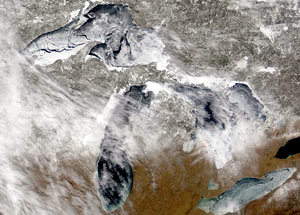
Here is an interesting article that came to my attention today about the lack of ice cover on the Great Lakes. Its talking about a report done by Dr. Jia Wang, an Ice Climatologist with the National Oceanic and Atmospheric Administration’s (NOAA) Great Lakes Environmental Research Laboratory in Ann Arbor, Michigan. They gathered data from 1979 to 2010 and have come up with the astonishing conclusion that the amount of ice cover on the Great Lakes has decreased by 71 % in that time period. According to this report, only about 5 % of the Great Lakes were covered by ice this winter as compared to 94% back in 1979.

Satellite image of Great Lakes courtesy of EarthSky

The lack of ice cover has some big implications for the lakes, including greater shoreline erosion in some cases, to earlier blooms of toxic blue-green algae. The lack of ice cover will contribute to warming of the waters which may please us human swimmers but will also have consequences for the aquatic ecosystems.

I’m currently seeking data on Lake Winnipeg’s ice cover to see how it compares to statistics in this report. In a blog a few months ago, I referred to data about the increased number of ice-free days on Lake of the Woods. In that report I was amazed to see that there was actually a whole month longer, on average, of ice free days with the lake freezing up two weeks later in the fall and thawing two weeks earlier in the spring.

Some of the effects of global warming are hard to dislike, such as the warmer weather we’ve been enjoying in Winnipeg these days. But, overall I think there are many good reasons for us to be paying more attention to this issue, because the negative impacts of global warming are becoming much more apparent.

Posted by: Vicki Burns | March 16, 2012

Algae Blooms and Public Health – Connections Are Being Made

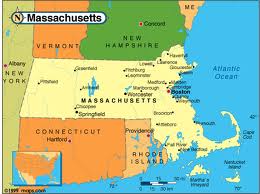
This article from an American newspaper in Massachusetts caught my attention yesterday because of the mention of the State Department of Public Health. I’m always on the lookout for information from other parts of the world that may have some relevance to our situation in Manitoba in relation to the deteriorating state of Lake Winnipeg. I think it is reasonable to be concerned that what is being said elsewhere about blue-green algae blooms may have implications for Lake Winnipeg.

map of Eastern United States

The State Department of Health is taking a proactive and public role in the situation in Plymouth County, Massachusetts. It seems to me that the public will be more likely to take notice of an issue if they can make the connection that it might have an impact on their health. Even though the Health Department is playing an important role in the Plymouth County blue-green algae challenge , citizens there understand that its going to take involvement from many different fronts to solve this problem. Its encouraging to see their action in creating a watershed committee and getting the public involved.

In Manitoba we have a good start on getting people in rural areas involved in watershed planning through their local Conservation Districts, but the majority of our population live in Winnipeg and have no understanding of their role in these water issues. It’s a challenge that we need to address in order to really get going on doing a better job of protecting our waters.

I was excited to open the Globe and Mail on Friday Feb.17 to read the headline “A Modest Proposal: Save the World” which provided details on a plan to wean us off fossil fuels. It offers easy to understand information from the Equinox Blueprint, a report put together by a group of scientists, business people and policy analysts organized by the Waterloo Global Science Initiative. I’m always looking for positive, proactive approaches to the major challenges we’re facing with climate change and this blueprint is exactly that.

image of planet earth from space

Planet Earth -image courtesy of NASA

So you might wonder why I’m writing about this in a blog about water and in particular the Lake Winnipeg Watershed. The Lake Winnipeg Foundation has recently adopted a position statement on Climate Change that provides the answer to this question. Essentially they are pointing out that changes in rainfall, runoff, evaporation, number of ice-free days on the lake, flooding, and drought are impacting the lake’s eco-system.The increasing water temperatures are contributing to the proliferation of toxic blue green algae and to invertebrate species changes which ultimately influence the Lake Winnipeg fish community. So anything that can be done to slow down the overall warming of the planet, will benefit Lake Winnipeg.

Many times, I hear people express a sense of being overwhelmed when the topic of climate change comes up. It seems so huge and so “out of our control”. That is why when I see the media publicizing something like the Equinox Blueprint which offers a real plan for how to get going, I am greatly encouraged. We humans do have an innate discomfort with making major changes but history has proven that we are very capable of doing so. I hope we can get moving now on making the major shift from fossil fuels to alternative energies. I believe there are more benefits than we can imagine.

Posted by: Vicki Burns | January 18, 2012

Peat Mining in Manitoba- Is It Connected to Lake Winnipeg?

Its only in the last few months that I have paid any attention to the issue of peat mining and how it might impact Lake Winnipeg. My attention was drawn to it by our own Manitoba government who included a section referring to peat mining in their Save Lake Winnipeg Act. In Part 3 of that Act they include a 2 year or longer moratorium on any new permits or leases for peat mining. So wouldn’t that lead you to believe that peat mining is damaging to the lake and that the government intends to stop any new peat mining from occurring?

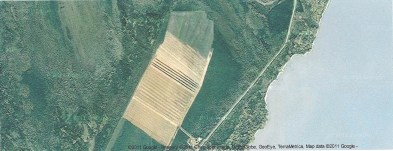
satellite picture of peat mine near lake shore

Google picture of existing strip peat mine on shores of Lake Winnipeg

I was very confused and frustrated to learn that there were several new applications for peat mine operations to begin very close to the shores of Lake Winnipeg in the Grindstone/Hecla area. It turns out that the Save Lake Winnipeg Act only stops new lease applications, not current lease holders from activating their leases. A number of individuals and organizations have recently begun to draw attention to this problem and try to stop new operations from being allowed.

There are two significant problems with peat mining from an environmental perspective. The first, in relation to blue-green algae blooms in Lake Winnipeg, is that the peat land is a type of wetland and performs a similar function to other types of wetlands in filtering water before it hits the lake. The peat land will slow the water down and soak up some of the phosphorus and nitrogen that contribute to the blue-green algae blooms. The mining of the peat involves basically cutting down everything in the mine site and then stripping off the peat layer. This will increase sediment run-off from this area as well as removing any filtering capacity of the land.Check out the picture above to see that it looks just like clearcutting when viewed from above.

The second very big problem is that stripping the peat will release large amounts of carbon to the atmosphere which is the opposite of what we’d like to see occurring at a time when global warming and its negative consequences,  are  becoming so evident. I hope that the government will end up doing the right thing and fulfilling the spirit of the Save Lake Winnipeg Act. If anyone is interested in submitting your comments to the public process about the current peat application # 5548.00 Hay Point Peat Mine you can do so at the Environment Assessment Licensing Branch of Conservation.

Here is a terrific example of how we can make a difference to Lake Winnipeg from within the city of Winnipeg at the same time as solving a water/drainage problem in a local community. The Drainage Inside the Dike project is the result of collaborative efforts of a number of different groups who occupy 11 hectares of flat land in St. Norbert that is subject to sitting water resulting from rain, melting snow, parking lot and building run off. This is commonly known as stormwater and around most of our city it is drained directly into our stormwater sewers. Those of us who are working on water and Lake Winnipeg issues now understand that  stormwater contributes some of the excess nutrients and pollutants that are causing water quality problems.

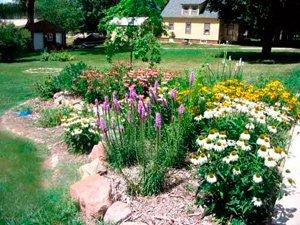
image of garden with native plants

Rain Garden with Native Plants

The St. Norbert Community Centre, St.Norbert Farmers’ Market, Place Saint-Norbert, Ecole Noel Ritchot and the Behavioural Health Foundation, as well as some concerned citizens have decided that they want to solve their water problems in an environmentally sustainable manner that won’t contribute further to Lake Winnipeg’s problems so they commissioned the design of the Drainage Inside the Dike project. In a nutshell, it’s a resculpting of land with berms, swales and rain gardens that will hold onto water and allow it to slowly seep into the ground instead of running off fast into the stormwater sewer system. Native plantings, such as big bluestem, black-eyed susans and buffalo grass, with their long roots, will soak up some of the phosphorus and nitrogen that we don’t want getting into our freshwater.

Janice Lukes, Coordinator of the St. Norbert Watershed Coalition, says groups need to think beyond their own property lines as water doesn’t respect those boundaries. All the groups involved are going to improve their own sites at the same time as decreasing their contribution to Lake Winnipeg’s problems. I’m excited to learn about this project because its such a good example of what we could be doing all over our landscapes to slow down water flows, decrease flood concerns and improve water quality.

« Newer Posts - Older Posts »

Categories