Posted by: Vicki Burns | July 24, 2012

Peat Mining Rush in Close Proximity to Lake Winnipeg

Today is the deadline for public comments on yet another peat mine permit(Sunterra Horticulture Canada Inc.) along the western edge of Lake Winnipeg. There have been several other permit applications in the past year in this same area, likely spurred by the Manitoba government’s announcement of a 2 year moratorium on new peat mine licenses in last year’s Save Lake Winnipeg Act. None of the new permit applications have been approved yet and are probably waiting till the provincial government completes their “ Manitoba Peatland Strategy”.
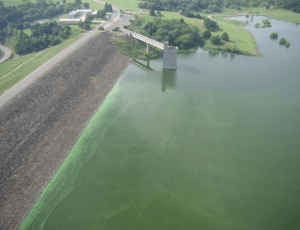
A few months ago I posted a blog which included an aerial picture of the current peat mine in this same area. It is quite striking how clearly it looks like strip mining and seems to confirm the concern about greater runoff from the land during heavy rain events. The Wilderness Committee has just released this colour coded map showing all the peat permit applications areas as well as where it is already occurring.
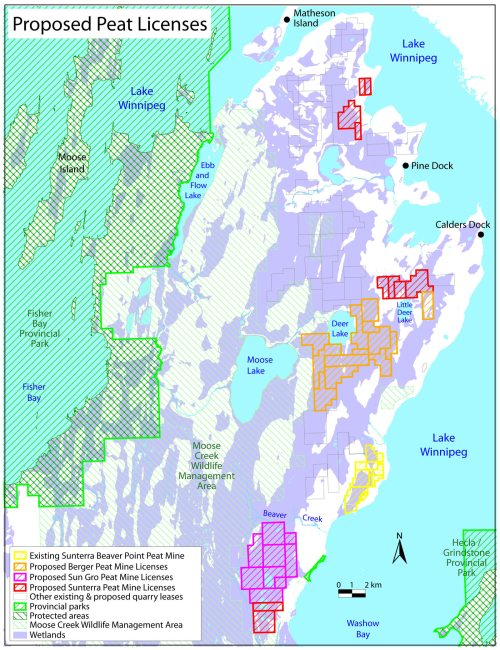
Proposed Peat Mines Map

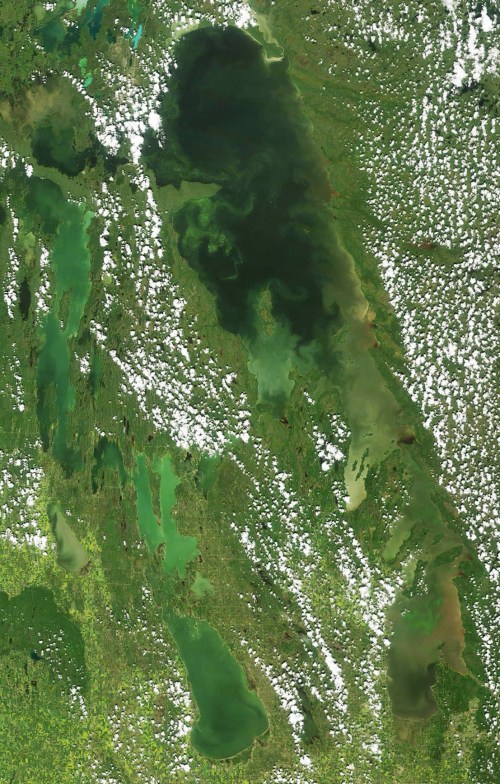
I put it alongside this recent satellite photo of Lake Winnipeg posted on the Lake Winnipeg Research Consortium’s website and I was struck by the presence of a blue-green algae bloom in the area of the lake very close to these peat mine applications. This is the same area where fishers encountered extreme “dirt” from submerged blue-green algae in their nets last fall. I don’t know if this area is often prone to getting the algae blooms but common sense would seem to suggest that we not do anything to exacerbate the problem any further.
Alex Salki, chair of the Lake Winnipeg Foundation’s Science Advisory Committee, shared this information recently. “A recent report by ICF Marbek for Environment Canada assesses the cost effectiveness of different strategies for reducing nutrient discharges to Lake Winnipeg (cost per tonne of phosphorus removed). This confirms previous Environment Canada conclusions (Wilson 2009) for water regulation, where wetlands and water filtration by forests provided the best cost-effectiveness, better than man-made management systems.” So one does have to wonder why we would be allowing the destruction of the best natural filtration systems?
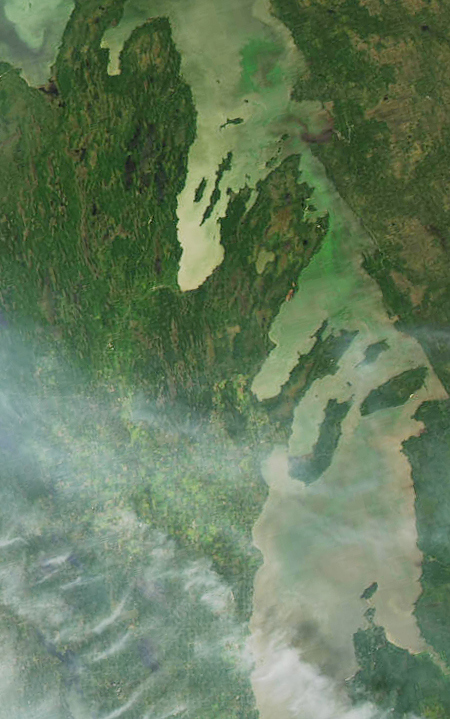
Satellite photo Lake Winipeg July 17 , from LWRC website
Posted by: Vicki Burns | July 13, 2012

Blue-green Algae Blooms Get an Early start in Manitoba

This weekend brought the first significant alert for blue-green algae blooms at 3 different locations in Manitoba. So our province is now joining the multitude of other locations around North America that are experiencing some toxic blooms. The appearance of blooms seems earlier this year than in the past and that is primarily due to the very hot weather and light rainfall in many areas, combined with last year’s overload of nutrients due to flooding.

In Manitoba there is a blue-green algae bloom at one end of Pelican Lake in southwestern Manitoba and there were two beaches on Lake Winnipeg that had some toxic blooms reported this weekend, one of the areas at Grand Beach and at Hillside beach. However there is another bloom developing in the north basin of Lake Winnipeg which is apparent in this satellite picture from July 8, posted by the Lake Winnipeg Research Consortium.

Satellite picture of Lake Winnipeg July 8 2012

The blooms in the north basin are not mentioned in the Manitoba government news releases, I presume because there are not public beaches up there.

Unfortunately this is likely just the start of these warnings for this year. With the continuing hot weather we’re probably going to see many more. Last weekend I was struck by the government’s news release which happily proclaimed that beaches were safe to swim at. I suddenly wondered how we had slipped into an era where we have to check every day whether the water is safe or not. It reminds me of being in Toronto in recent years and hearing smog alerts with advice about whether children could play outside or not. These seem to me to be such basic warnings about how much we’re degrading the natural world we’re so dependent on. Let’s hope we can move quickly to start to reverse these declines.

Over the past few weeks I’ve been keeping a lookout for news of blue-green algae blooms around North America and other parts of the world. In the US there have been numerous reports of algae blooms much earlier in the season than normal, likely due to the excessive heat. The states of Vermont, Wisconsin, Washington, Nebraska, Oklahoma, New York and Massachusetts have all issued various warnings to the public about lakes that have blue-green algae blooms and the caution members of the public should take when near those lakes. Some are going as far as closing the lakes to any public use which is taking a big toll on businesses in the area.

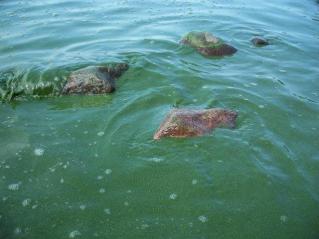
Blue-green algae Lake Winnipeg 2012

Today, I was very interested to see this article from the European Commission linking rising temperatures to more algae blooms. Researchers from Denmark, Germany, the Netherlands, Norway and Sweden have shown that for  the Baltic ecosystem, rising temperature plays a role in fostering the addition of the nutrients that feed the algae blooms and they predict that a continued rise in temperature will only make the problem worse.

I was heartened to learn that Australia has just brought into being a carbon tax to try to use cost as a factor in decreasing the country’s dependency on fossil fuels. It’s a very controversial move because some of the public are not convinced that it is necessary but I think the Australian government is demonstrating the kind of courageous leadership we need in order to make any significant progress in slowing global warming. The ramifications of our planet heating up are all around us, more violent storms, more flooding, increased drought and as some research is showing , increased toxic algae blooms fouling our waters. There are so many good reasons to wean ourselves off fossil fuels and move towards renewable energy, its encouraging to see Australia taking action. I hope Canada will follow their lead.

I don’t usually post anything like jokes but this one is so clever and so full of relevant information, I just couldn’t resist. Do you agree?

Unnaturally perfect lawn

God said: “Frank, you know all about gardens and nature. What in the world is going on down there on the planet? What happened to the dandelions,violets, milkweeds and stuff I started eons ago? I had a perfect no-maintenance garden plan. Those plants grow in any type of soil, withstand drought and multiply with abandon. The nectar from the long-lasting blossoms attracts butterflies, honey bees and flocks of songbirds. I expected to see a vast garden of colors by now. But, all I see are these green rectangles.”

St. FRANCIS: It’s the tribes that settled there, Lord. The Suburbanites. They started calling your flowers ‘weeds’ and went to great lengths to kill them and replace them with grass.

GOD: Grass? But, it’s so boring. It’s not colorful. It doesn’t attract butterflies, birds and bees; only grubs and sod worms. It’s sensitive to temperatures. Do these Suburbanites really want all that grass growing there?

ST. FRANCIS: Apparently so, Lord. They go to great pains to grow it and keep it green. They begin each spring by fertilizing grass and poisoning any other plant that crops up in the lawn.

GOD: The spring rains and warm weather probably make grass grow really fast. That must make the Suburbanites happy.

ST. FRANCIS: Apparently not, Lord. As soon as it grows a little, they cut it-sometimes twice a week.

GOD: They cut it? Do they then bale it like hay?

ST. FRANCIS: Not exactly, Lord. Most of them rake it up and put it in bags.

GOD: They bag it? Why? Is it a cash crop? Do they sell it?

ST. FRANCIS: No, Sir, just the opposite. They pay to throw it away.

GOD: Now, let me get this straight. They fertilize grass so it will grow. And, when it does grow, they cut it off and pay to throw it away?

ST. FRANCIS: Yes, Sir.

GOD: These Suburbanites must be relieved in the summer when we cut back on the rain and turn up the heat. That surely slows the growth and saves them a lot of work.

ST. FRANCIS: You aren’t going to believe this, Lord. When the grass stops growing so fast, they drag out hoses and pay more money to water it, so they can continue to mow it and pay to get rid of it.

GOD: What nonsense. At least they kept some of the trees. That was a sheer stroke of genius, if I do say so myself. The trees grow leaves in the spring to provide beauty and shade in the summer. In the autumn, they fall to the ground and form a natural blanket to keep moisture in the soil and protect the trees and bushes. It’s a natural cycle of life.

ST. FRANCIS: You better sit down, Lord. The Suburbanites have drawn a new circle. As soon as the leaves fall, they rake them into great piles and pay to have them hauled away.

GOD: No!? What do they do to protect the shrub and tree roots in the winter to keep the soil moist and loose?

ST. FRANCIS: After throwing away the leaves, they go out and buy something which they call mulch. They haul it home and spread it around in place of the leaves.

GOD: And where do they get this mulch?

ST. FRANCIS: They cut down trees and grind them up to make the mulch.

GOD: Enough! I don’t want to think about this anymore. St. Catherine, you’re in charge of the arts. What movie have you scheduled for us tonight?

ST. CATHERINE: ‘Dumb and Dumber’, Lord. It’s a story about….

GOD:

Never mind, I think I just heard the whole story from St. Francis

Posted by: Vicki Burns | June 22, 2012

Shoreline Erosion Prevention on Lake Winnipeg

Last week I participated in a tour organized by the Manitoba Conservations Districts Association in partnership with the East Interlake Conservation District( EICD). They were showcasing some of the progressive projects that are happening within their conservation district. It was a very informative day, having the opportunity to see in real life some of the good work going on, as well as an opportunity to connect with people from across Manitoba who are working in conservation districts.

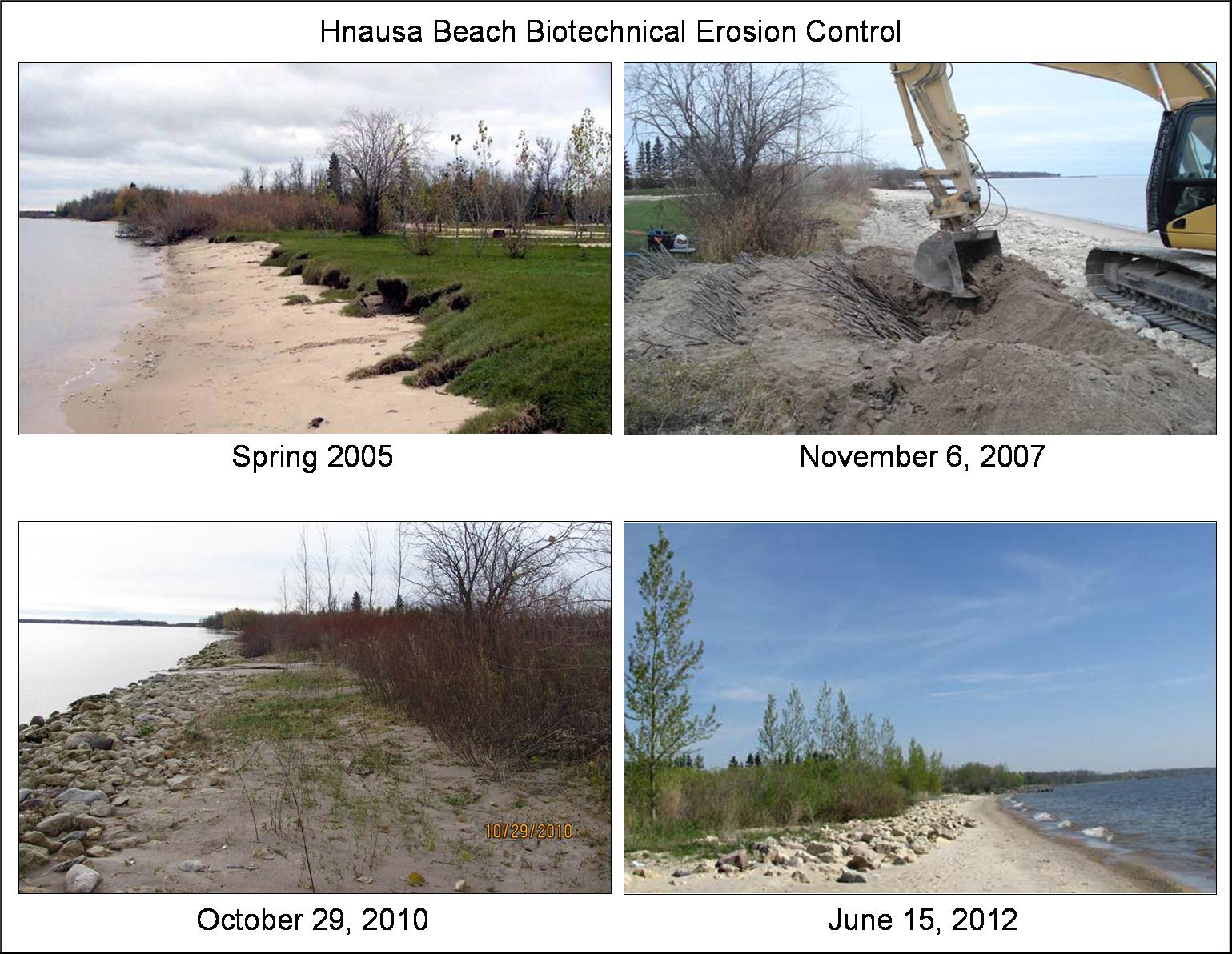
Hnausa Beach before and after willow planting, photo courtesy of Todd Schwartz

One of the projects that really caught my attention was a shoreline erosion prevention project at Hnausa Beach Park that was using a bio-technical engineering approach. It was combining the soil bioengineering approach of planting willows with the engineering approach of adding rocks. Todd Schwartz, Fish Habitat Biologist with DFO Canada, who was in charge of this willow planting project, explained that one of the most important features for the success of this project was the gentle slope that was employed. The angle of the slope trips the waves and allows them to drop their sand rather than a steeper vertical slope which causes them to bounce back taking the sand back out with them. The willow roots help to hang onto the soil. I was impressed to learn that this approach at Hnausa Beach survived the big weather bomb of October 2010 , while the beach right alongside that did not have the willow planting lost about 2 to 3 meters. The bio-technical approach is not a perfect solution for every situation but it certainly seems to help in some.

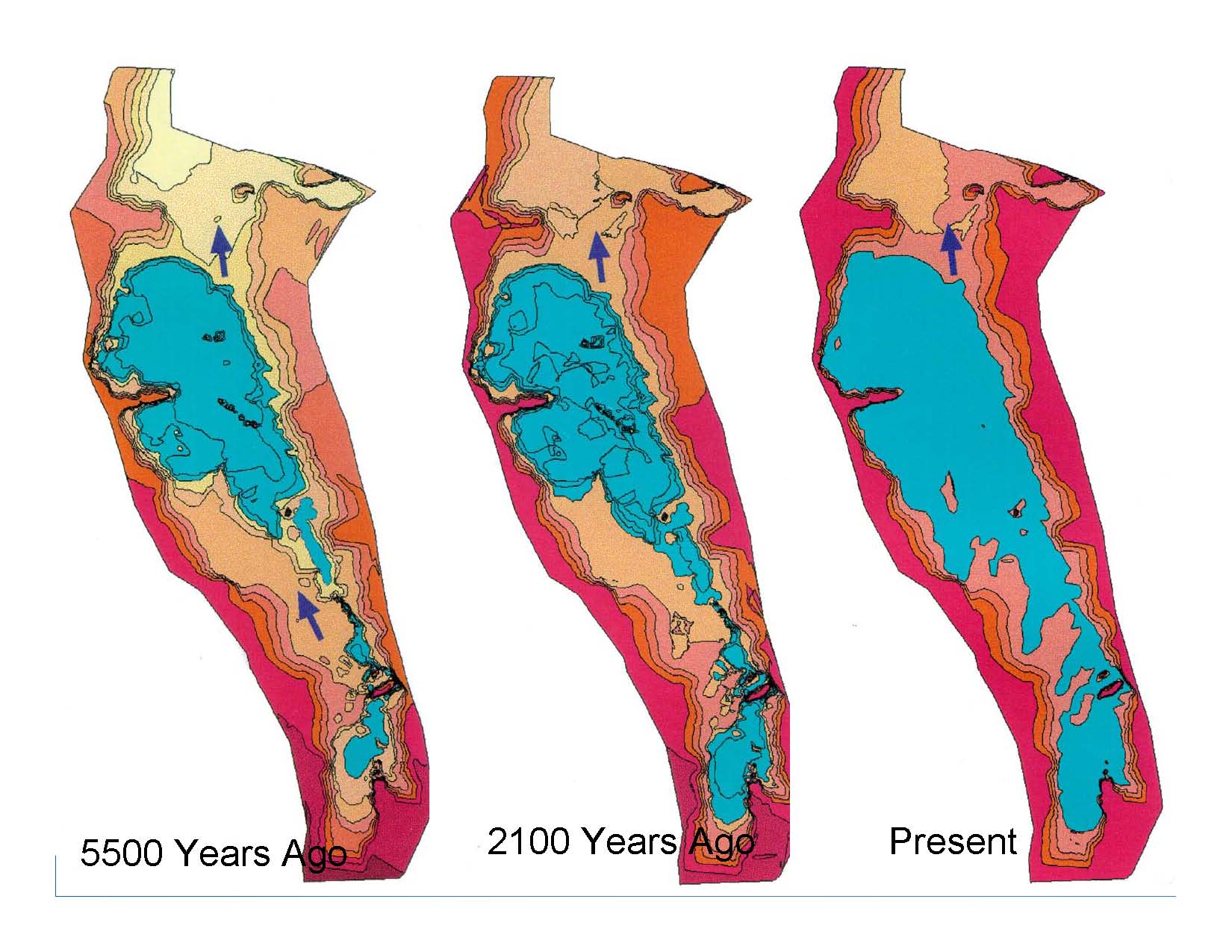
There is a wealth of information in the province of Manitoba’s Shoreline Management Handbook and advice available from the Shoreline Erosion Technical Committee for homeowners. One concept that I think we all need to accept though, is that some erosion is a basic natural process and over time the lake’s shoreline is going to change. It’s a hard fact to accept if you have a home close to the water’s edge.Check out this map of Lake Winnipeg over the past 5500 years. Its fascinating to see how the lake has expanded.

image of 3 maps of Lake Winnipeg showing the lake expanding over 5500 years

Map of Lake Winnipeg over last 5500 years courtesy of Manitoba Hydro

image of pond surrounded by reeds and prairie grasses

Wetland on the Prairies

A few days ago I received a copy of Ducks Unlimited Canada’s submission to the province of Manitoba’s Surface Water Management Strategy consultation. As I expected, it was well-written with lots of interesting and specific examples of wetland drainage contributing to the worsening of floods over the past couple of decades. As they put it so succinctly “Channelization and wetland drainage do a great job at what they are intended do – and that is facilitating and accelerating the movement of water onto downstream neighbours.”

As many of us working on water issues in Manitoba know, Lake Winnipeg is the ultimate downstream recipient of floodwaters and all that they bring with them. It is well recognized that floodwaters carry   excess nutrients, phosphorus and nitrogen, that fuel the growth of blue-green algae. So decreasing flooding will be a huge benefit to water quality in the lake, not to mention all the other important reasons why we want to decrease flood threats.

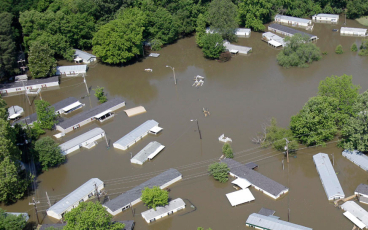
Mississippi River Flood in Memphis 2011

One of the items in the DUC report that really caught my attention was a description of several studies done in the Mississippi River Valley that demonstrated the contribution of wetland drainage there to greater river flow rates. One of the studies concluded that a restoration of seven percent of the watershed could provide enough water storage to deal with an extreme flood event on a large scale. Another study done by the U.S. Army Corps of Engineers recommended the acquisition and protection of wetlands as the least expensive method of flood control. The Charles River Basin Authority subsequently paid $10 million to acquire 3,400 hectares of wetlands which act as a natural storage area for flood control. The same amount of flood control provided by the conventional dams and levees would have cost $100 million. So saving wetlands can be a big cost saving as well.

Posted by: Vicki Burns | June 5, 2012

Blue-Green Algae Closes Northern Ireland Lake

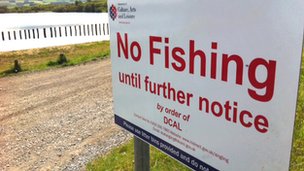
Loughbrickland Lake in Northern Ireland is the latest casualty of toxic blue-green algae blooms. I came across this news a few days ago announcing that the lake has been closed to the public, including fishing due to the algae bloom in the lake. Apparently it has happened there before and their public health officials are warning the public not to eat fish coming from the lake.

No Fishing Sign in Northern Ireland

We don’t see that type of warning in Manitoba, related to fish coming from lakes with blue-green algae blooms, and I hope that we don’t. It is clear that we need more ongoing research here on Lake Winnipeg to determine what toxins, if any, may be accumulating in our fish. We have a multi-million dollar fishing industry that provides a living to a thousand Manitobans. It would be terrible to have anything threaten that industry and having up-to-date reliable data on what is happening here may be the best defence.

Posted by: Vicki Burns | June 4, 2012

Black Out Speak Out

Posted by: Vicki Burns | May 28, 2012

New Report Strengthens Call for National Water Strategy

Cross-Canada Checkup: A Canadian Perspective On Our Water Future is a report compiled by the University of Victoria’s POLIS Project and Simon Fraser University’s Adaptation to Climate Change Team. It is based largely on findings that came out of Bob Sandford’s cross-Canada tour last fall. Sandford is one of Canada’s foremost experts on water issues and is spending his time promoting the idea that Canada is in great need of a national water strategy that would set basic standards and policies in place across our country.

image of report cover - Cross-Canada Checkup

Cross-Canada Checkup Report

Each province that Sandford visited last fall had its own particular issues in relation to water. Here in Manitoba, I was one of the people on the panel who spoke along with Bob. One of our greatest challenges is the deteriorating condition of Lake Winnipeg and some of our other lakes as a result of growing blue-green algae blooms fouling the lakes. As well the shocking lack of clean, safe, running water on many of our northern First Nations communities was highlighted.

When I asked Bob what he thought the most important message from the report was, he responded that although Canadians think water is our most important natural resource, they continue to have the erroneous belief that we have a never-ending supply and that we are being careful with it. In fact, on average we’re using 329 litres per day, more than double what most other developed countries use.

We need to move quickly towards developing national policies that will ensure we’re using water in the wisest and most sustainable ways possible. Bob’s work with the UN on water issues is aptly named “Water for Life”. Our challenge is to create a Canadian water strategy that will ensure “Water for Life” for many generations.

I’ve been following the news about health alerts for toxic algae blooms and was surprised to see some appearing for lakes in both Kansas and Oklahoma already this season. Those states are directly south of Manitoba, although over 1200 kilometers away.

image of lake with very green colour from algae bloom

Milford Lake, Kansas Toxic Algae bloom 2011- photo courtesy of KDHE

Unfortunately, there have already been 2 dog deaths in southern Oklahoma as a result of the dogs ingesting some of the toxic algae. Many people are still not aware that their pets can be at serious risk if they go into water in which the blue-green algae are present. Its not simply that the dogs are drinking the water but they tend to lick themselves when they get out of the water so can be ingesting some of the toxins during that process.

Officials in Kansas were issuing warnings to the public this week, in light of events in 2011.  Last year, blue-green algae outbreaks in public lakes killed at least five dogs and sickened at least 13 people. Kansas Department of Health and the Environment issued warnings at 16 lakes last year. They are uncertain if this year will be as bad as last year for the toxic blooms but they’re not taking any chances in making sure the public is informed of the risks.

In Manitoba, we are hoping that any alerts about blue-green algae blooms will be at least 2 months away. Lake Winnipeg is such a huge lake, covering almost 25,000 square kilometers, as well as our warm season starting later, that the blooms usually don’t appear till much later in the season.

Tomorrow Living Lakes Canada is holding their first annual meeting in Winnipeg and kicking off a conference co-hosted by the Lake Winnipeg Foundation. The focus will be on climate related factors that are contributing to the increasing algae blooms. Hopefully we’ll see more action coming out of this conference to start reversing the trend of the last couple of decades. Less rather than more is what we want when it comes to blue-green algae blooms.

« Newer Posts - Older Posts »

Categories